
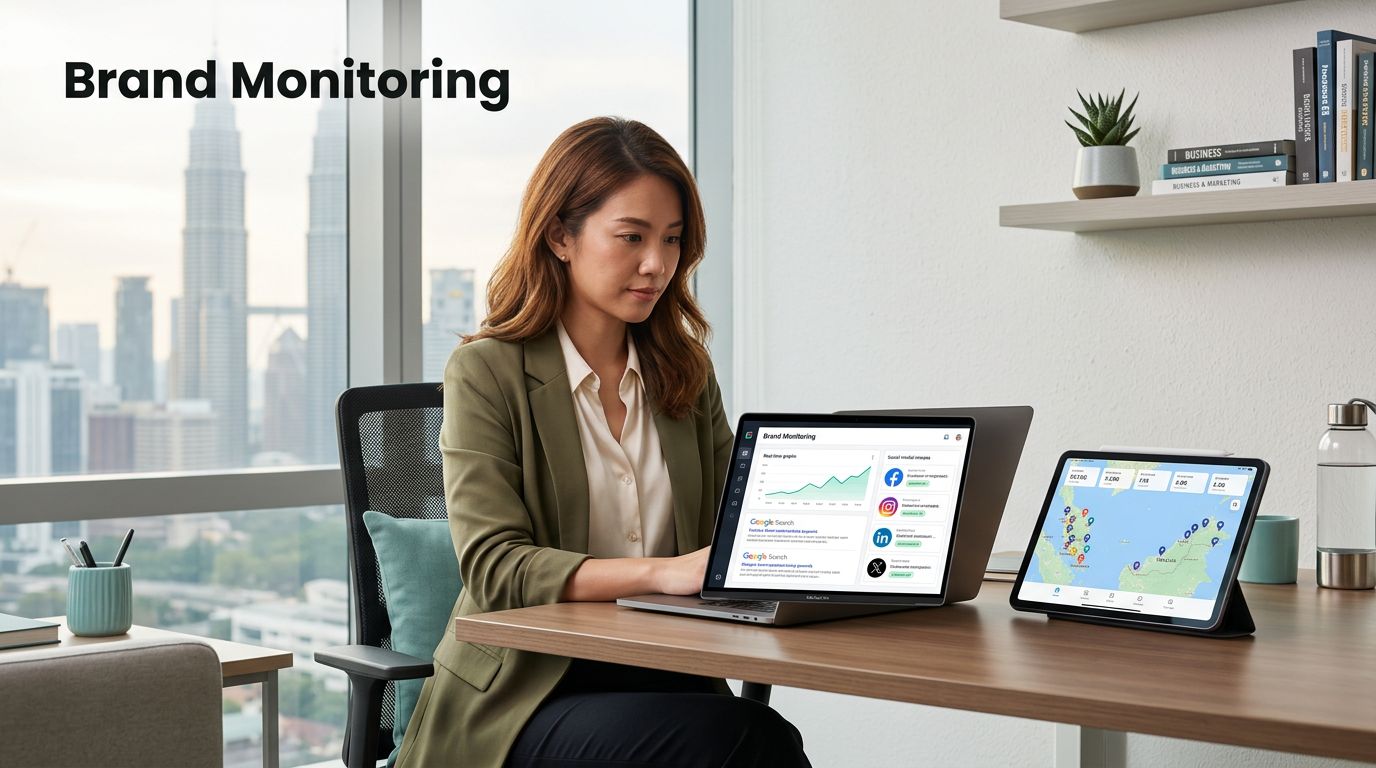
Brand monitoring is the ongoing process of tracking where a business, product, founder, or campaign appears online and how people describe it. For Malaysian SMEs, startups, local service providers, and eCommerce stores, it helps make sense of their digital footprint and customer conversations.
A customer may post a complaint on Facebook, compare prices in a Lowyat.NET thread, or leave a review on Google Maps before your team notices. These brand mentions can shape brand visibility in search, brand awareness, enquiries, calls, bookings, WhatsApp leads, and sales. Brand monitoring helps you find useful signals across search results, reviews, news, forums, competitors, and AI-generated answers before they become missed opportunities.
Key Takeaways
- Use brand monitoring to track tagged social posts, reviews, search results, forums, news, and customer feedback.
- Monitor English and Bahasa Malaysia terms, including user-generated content from reviews and marketplace posts.
- Treat AI-generated answers and ai visibility as developing signals, not guaranteed ranking channels.
- Set real-time alerts for complaints, high-reach mentions, review changes, and urgent phrases.
- Use brand monitoring to turn recurring customer questions into stronger content, service processes, and lead-generation pages.
What Is Brand Monitoring and How Does It Work?
Brand monitoring gathers public references to your business, then sorts them into issues your team can act on. It differs from social media monitoring, which focuses on social platforms. Social listening looks for broader conversation patterns, while brand reputation work focuses on responding to public perceptions. Brand tracking measures longer-term awareness and sentiment.
This brand monitoring workflow starts with search terms. Include your brand name, common misspellings, product names, founder names, campaign hashtags, competitors, and category keywords. Collect brand mentions, filter irrelevant results, classify useful ones, alert the right person, and record the action taken. Use competitor analysis and social intelligence to turn raw conversations into decision-ready information.

Which Online Channels Should Your Business Track?
Watch Facebook, Instagram, TikTok, LinkedIn, X, Reddit, Google Search, news sites, blogs, podcasts, forums, and industry review platforms. Media monitoring should also cover Google Business Profile reviews, Shopee and Lazada feedback, and relevant Malaysian communities such as Lowyat.NET. Look for untagged mentions in news coverage, forums, reviews, and community discussions.
Track terms in English and Bahasa Malaysia when customers use both. A restaurant may need to watch words such as “sedap,” “mahal,” “slow,” or “rude” alongside its name. Private groups and closed communities may remain invisible because monitoring platforms cannot access every conversation.
Why AI Visibility Is Now Part of Brand Monitoring
Google AI Overviews and other ai-powered systems can describe brands, services, and competitors before someone visits a website. Review ai visibility for your brand, major services, comparison queries, and common customer questions.
AI SEO, AEO, GEO, entity SEO, and LLM optimization are practitioner terms, not official Google product categories. Still, clear business details, accurate structured content, current reviews, and reliable third-party sources can support ai visibility. These signals help systems understand your company and select relevant information.
AI answers and citations vary by query, location, language, user context, and platform. Monitor changing results to understand your ai visibility over time. A structured brand monitoring process can treat these results as a developing signal rather than a fixed ranking.
For a more structured approach, use this guide on how to measure AI search visibility.
Why Brand Monitoring Matters for Malaysian Businesses
Mention counts alone don’t pay the bills. Brand monitoring creates value by revealing issues and opportunities that shape customer decisions and protect brand reputation.
A Kuala Lumpur clinic can spot recurring questions about appointment availability. A Selangor contractor can catch a service complaint before it becomes a damaging review pattern. Restaurants can identify repeated comments about wait times. B2B firms can follow industry discussions where buyers compare providers. These conversations support market research and can influence ai visibility.
Catch Reputation Problems Before They Spread
A sudden jump in negative mentions or words like “scam” and “fake” can damage public perception. Inaccurate claims about your services also require timely review. Mention volume still needs interpretation through sentiment analysis. First, verify the facts. Then respond calmly and move sensitive cases to a private channel when appropriate.
A public reply should show accountability to future customers, not win an argument with one unhappy person.
Keep a clear escalation path for legal claims, safety issues, data concerns, or a fast-moving crisis, with crisis management steps ready. Don’t delete fair criticism or answer complaints with aggressive sales language.
Turn Customer Feedback Into Better Marketing and Operations
Repeated customer feedback often exposes a gap in your website copy, service process, or support script. Comments about pricing confusion may call for clearer packages, while user-generated content can reveal friction in the customer experience. Frequent product requests may guide content priorities or product decisions.
Look for patterns instead of reacting to every isolated post. This is where brand monitoring for SEO visibility connects customer language with stronger pages, FAQs, and search-focused content while supporting brand health.
The Metrics That Make Brand Monitoring Useful
Use brand monitoring to measure only what helps your team decide what to do next. Start by recording a normal baseline for two to four weeks, then set thresholds for unusual changes.
A focused brand monitoring dashboard can show brand health through mention volume, sentiment trend, category conversation share, top sources from media monitoring, reach or engagement, response time, and the topics driving discussion. Use sentiment analysis to sort large volumes. However, sentiment analysis can miss sarcasm, mixed feedback, and Bahasa Malaysia context.
Measure Search Visibility, AI Visibility, and Share of Voice
Review branded search results, competitor mentions, review exposure, and the share of voice linked to your business. Google Search Console can show branded searches and page impressions, although it cannot reveal every AI citation or AI Overview appearance.
To assess ai visibility, record the prompt, date, region, language, answer type, and cited sources. For comparison, record ai visibility using the same prompt, region, language, answer type, and citations over time. Avoid treating a single AI answer as proof of stable ai visibility.
Set Alerts Around Business Risk, Not Every Mention
Use real-time alerts for sharp volume spikes, high-reach sources, executive mentions, major reviews, product issues, and urgent negative phrases. Boolean filters, location filters, and product filters reduce false positives.
Use simple urgency tiers. A positive customer post may need a thank-you. A complaint needs a service response. A serious allegation needs management review. Track both response time and the time from detection to decision.
How to Choose Brand Monitoring Tools for Your Business
Google Alerts, Brand24, Mention, Awario, Sprout Social, Brandwatch, Meltwater, Talkwalker, and Hootsuite support different channels and workflows. No platform captures every online conversation, so compare coverage before choosing.
Small teams can start with Google Alerts, a narrow keyword list, Google reviews, priority social channels, and local news. Larger organizations may need broader geographic coverage, media monitoring, social media monitoring, detailed reporting, permissions, integrations, and brand tracking.
What to Check Before You Subscribe
Test whether a tool finds untagged mentions, local news, review platforms, Bahasa Malaysia conversations, competitor terms for competitor analysis, and image or logo mentions. Check its ai visibility coverage, including relevant AI search results, and whether ai-powered features automate classification or discovery.
When comparing a trusted AI SEO agency or software provider, ask how it handles source gaps and turns conversation data into social intelligence. Review data retention, exports, user permissions, alert controls, onboarding support, irrelevant-result filtering, and ai visibility reporting. A useful brand monitoring setup should support business decisions, not produce a crowded dashboard nobody checks.
A Simple Brand Monitoring Plan for Startups and Small Businesses
Start your brand monitoring setup with your brand name, common misspellings, services, products, founders, competitors, and high-value category terms. Prioritize branded Google results, key review pages, major social channels, local news, and forums, while using social listening to uncover customer language beyond routine alerts. Include untagged mentions in your searches where possible.
Assign one person to check alerts and receive real-time alerts for urgent mentions. Create response rules, record useful findings, and review your search terms every quarter as your offers and market change.
Create a Practical Response Workflow
Use brand monitoring to sort mentions into positive feedback, genuine complaints, questions, misinformation, spam, and possible crises. Set crisis management rules that define who replies, when customer service takes over, and when management approves a response.
Document the issue, response, owner, and outcome. Then close the loop with the customer where possible. Helpful, transparent replies build more trust than scripted promotion.
Connect Monitoring Findings to SEO and Lead Generation
Use brand monitoring findings to understand the words customers use and the concerns affecting their customer experience. Customer feedback can improve service pages, FAQs, internal links, Google Business Profile updates, and conversion paths. These changes can strengthen brand visibility, while AI-search findings provide an additional ai visibility insight.
Businesses that need help joining reputation insights with organic growth can review their SEO strategy with PixelPro.
Common Brand Monitoring Mistakes to Avoid
Many businesses rely on social media monitoring for tagged posts alone, missing untagged mentions, reviews, and branded search results. Others use broad keywords, filling reports with irrelevant noise.
Don’t trust automated sentiment analysis without checking sarcasm, context, or local-language meaning. Automated signals, including ai visibility data, also need human verification. Use social intelligence to assess the source, topic, and business relevance, rather than volume alone. Defensive replies, unclear ownership, and ignored Bahasa Malaysia criticism can damage brand reputation. Brand monitoring matters only when somebody can assess, decide, and act.
Frequently Asked Questions
How often should a small business review brand mentions?
Use brand monitoring to check priority alerts daily or at least several times each week. Review broader trends monthly, since meaningful patterns need more context than a single mention.
Can brand monitoring find fake reviews?
It can help you spot suspicious review patterns quickly. Document the review, check your records, and report policy violations through the relevant platform. Respond publicly with care to protect your brand reputation.
Should founders monitor their own names?
Yes, founders should include their names in brand monitoring when they’re visible in sales, media, or industry discussions. Founder mentions can affect trust, especially for startups, professional firms, and B2B companies.
Does brand monitoring replace customer surveys?
No. Monitoring captures unsolicited public feedback, while surveys let you ask targeted questions. Both sources provide different types of customer feedback and reveal different parts of the customer experience.
Can monitoring improve local SEO?
It can uncover inaccurate business details, recurring review themes, and location-specific questions. These findings can support better local pages, Google Business Profile optimization, and supporting ai visibility clues, but they don’t guarantee AI rankings.
A More Useful View of Your Brand
Effective brand monitoring turns mentions into action, helping Malaysian businesses improve brand reputation, brand visibility, and brand awareness. Review customer conversations, reviews, search results, competitors, and AI answers as an emerging ai visibility signal. Use these insights to strengthen the customer experience, refine content, respond to issues, and understand your share of voice.
A recommended ongoing process is to keep brand monitoring focused on recurring checks, clear priorities, and measurable improvements. If your Malaysian business needs a practical view of website performance and ai visibility, request an SEO review with PixelPro, and make brand monitoring part of that next step.
