
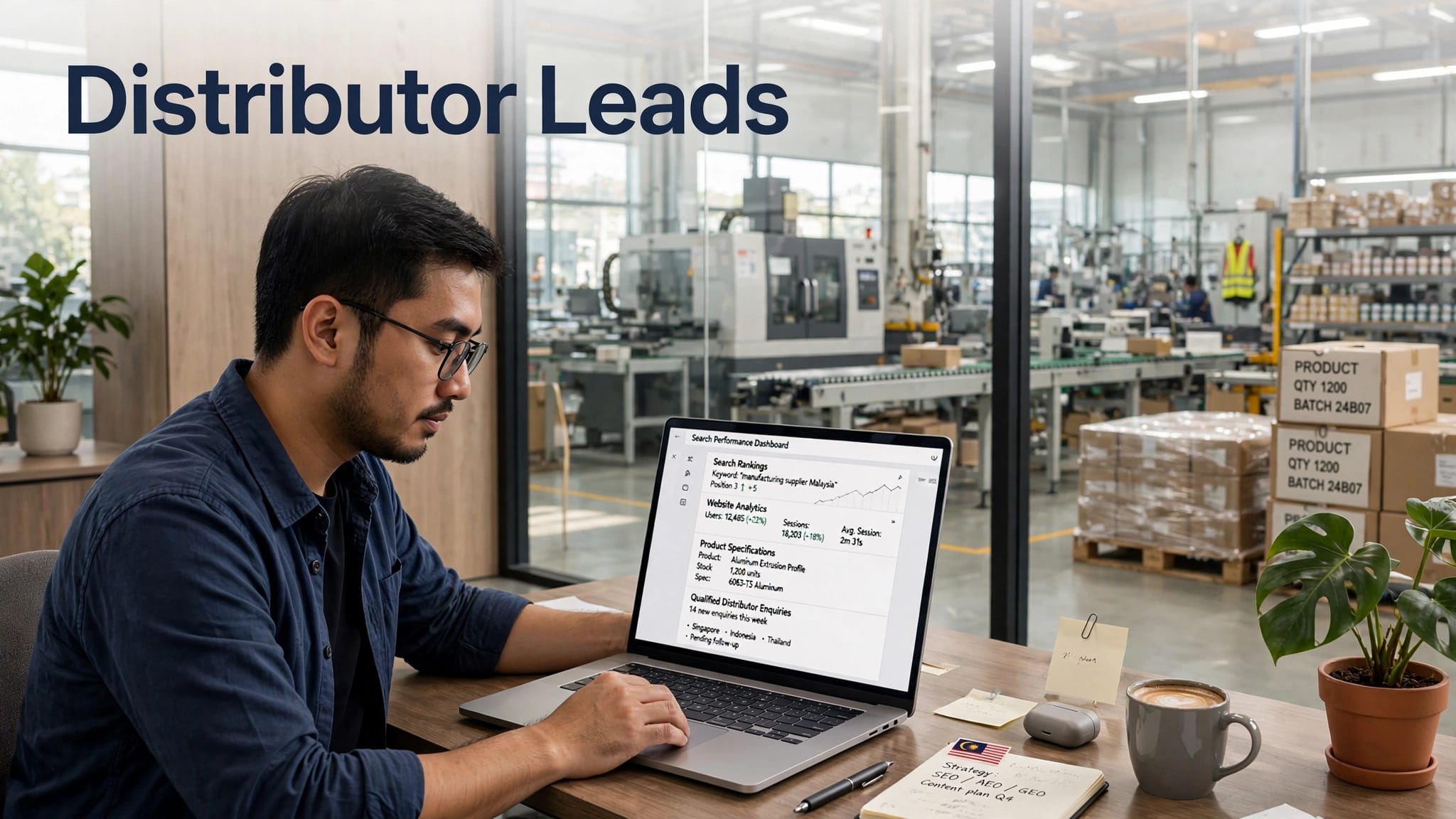
A distributor searching for a reliable Malaysian supplier rarely begins with a broad search. They look for a product specification, manufacturing process, material grade, certification, or supply capability that matches an active requirement.
This focused search strategy helps your company appear for those high-intent searches and guide buyers towards a meaningful enquiry. The goal is not traffic for its own sake. It is more quotation requests, sample enquiries, factory calls, WhatsApp conversations, and distributor discussions.
A strong search presence begins by matching your website to how industrial buyers research, compare, and shortlist suppliers.
How manufacturer SEO Malaysia generates distributor leads
Direct answer: Manufacturer SEO Malaysia combines technical SEO for a healthy, discoverable website, product-focused content, clear proof of capability, and measurement. It helps distributors find relevant manufacturing pages when they search for a supplier, rather than landing on a generic corporate profile.
A distributor may search “OEM plastic injection moulding Malaysia”, “halal certified food manufacturer”, or “industrial fastener supplier Selangor”. Each phrase reveals a different need and can attract organic search traffic from a specific buyer, rather than general traffic.
Your website needs a dedicated, useful page for that need. Product pages can turn industrial searches into qualified conversations when they provide the information buyers need, supporting B2B lead generation.
High search engine rankings matter, but accepted distributor enquiries matter more. Clear quote, sample, call, and WhatsApp paths support conversion rate optimization by improving the percentage of suitable visitors who enquire.
A page that attracts 50 procurement managers is more useful than a broad article that draws 5,000 unrelated visitors.
Industrial SEO works best when each important page gives a buyer enough evidence to move from research to contact.
Key takeaways for manufacturing owners
- Build pages around products, sectors, processes, certifications, and supply capabilities that buyers actively search for.
- Make it easy to request specifications, quotes, samples, factory visits, or distributor terms.
- Track enquiry quality in a CRM or sales sheet, not only keyword positions.
- Add AI-search-ready content without abandoning proven search engine optimisation basics.
Start with the distributor’s buying journey
B2B manufacturing searches often take place over weeks or months. A buyer may first confirm material options, then compare suppliers, and finally request pricing from a shortlist. For manufacturers seeking distributor enquiries, the buying journey should guide keyword research across product, process, material, location, certification, MOQ, and customisation intent.
Capture searches with clear commercial intent
Product and service pages should target purchase-intent terms, with on-page optimisation applied to headings, specifications, internal links, and enquiry prompts. These terms include product type, manufacturing method, industry, location, compliance standard, minimum order quantity, and customisation option.
For example, an aluminium fabricator could build distinct pages for CNC bending, powder coating, custom enclosures, and contract production. Combining all services on one page makes it harder for search engines and distributors to understand the offer.
Each page should state the product range, material options, production capacity, quality processes, industries served, lead-time factors, and a clear route to enquiry. Avoid publishing specifications that you cannot maintain.
Answer research questions before competitors do
Informational content can introduce your company before a buyer is ready to contact suppliers. For manufacturers seeking distributor enquiries, a content marketing strategy should prioritise practical research topics over high-volume consumer content. These might include “how to choose food-grade packaging”, “OEM versus private-label manufacturing”, and “how ISO certification affects supplier selection”.
These articles should link naturally to related service and product pages. That internal path helps visitors continue their research while showing Google which pages carry the most commercial importance.
Build a website that search engines can crawl
Even strong product information can underperform when crawlers struggle to access it. Technical SEO removes barriers that hide valuable pages from Google and frustrate mobile buyers.
Google’s SEO Starter Guide remains a sensible baseline. Search engines need accessible pages, descriptive links, logical site structure, and content that clearly explains its purpose.
Audit the manufacturing website before adding content
A comprehensive website audit should review index coverage, redirects, duplicate URLs, broken links, mobile usability, XML sitemaps, robots directives, canonical tags, page performance, and Core Web Vitals. It should also use Core Web Vitals to assess mobile and template performance, then check whether PDF catalogues contain product information that belongs on searchable HTML pages.
Many manufacturers rely on image-heavy catalogues or outdated PDFs. These files may help a buyer, but they are weak substitutes for focused product pages with readable copy, technical tables, and enquiry options.
Use a Malaysia SEO audit checklist to assess technical SEO priorities in order. Fixing blocked pages, duplicate product variations, or poor Core Web Vitals often has more value than publishing another general blog post.
Use structured data and consistent entities
Entity SEO helps search systems connect your company name with its products, facility, certifications, leadership, and markets. Keep your legal business name, address, phone number, descriptions, and brand details consistent across the website and verified profiles.
Structured data gives search engines machine-readable context for pages. Google’s structured data introduction explains how this markup can help Google understand content. Use valid structured schema markup only for visible, accurate organisation, product, breadcrumb, or FAQ information.
Schema is not a shortcut to rankings. It supports information that must already be visible, correct, and useful to the visitor.
Turn technical knowledge into searchable proof
Manufacturing buyers need details that a polished homepage rarely provides. They assess risk, consistency, compatibility, and supplier reliability. Your website should answer these concerns in plain language.
Create pages that mirror real product decisions
A high-value product page can include dimensions, materials, tolerance ranges where appropriate, compatible applications, available finishes, quality checks, packaging options, and order requirements. It can also explain whether you handle prototyping, private labels, contract manufacturing, or export documentation.
Use descriptive headings instead of vague labels such as “Our Solutions”. A distributor should understand the page within seconds. Clear headings also help answer engines identify the topic and supporting details.
Content for manufacturer SEO Malaysia should show genuine operational knowledge that differentiates your expertise. Interview production managers, sales engineers, and quality teams. Their input produces details that generic AI-written copy usually misses.
Support claims with evidence buyers recognise
Add current certificates, test standards, factory photos, process explanations, case examples with permission, and named industries served. If a claim needs qualification, state the condition clearly.
Authoritative links also matter as part of off-page SEO, complementing the evidence on your site. A selective link building strategy can focus on references from trade associations, reputable industry publications, customer partners, or relevant supplier directories. These sources can validate your business when they are genuine and relevant.
Good backlinks management means monitoring the quality, relevance, and acquisition of external links. However, avoid purchased link schemes and mass directory submissions. Google’s spam policies prohibit tactics that manipulate rankings.
AI SEO, Answer Engine Optimization, and Generative Engine Optimization for industrial suppliers
Traditional SEO helps pages rank in search results. AI SEO adds work that makes your business and expertise easier for AI-powered search features to interpret, compare, and reference. It still depends on technical SEO, including crawlability, accessible content, logical site structure, and reliable first-party information.
AEO, or Answer Engine Optimization, focuses on concise answers to specific buyer questions. GEO, or Generative Engine Optimization, strengthens the content, entity signals, and website structure that generative systems use when forming responses. AI search optimization brings these elements together through direct answers, clear entity information, consistent terminology, structured pages, and evidence that AI systems can interpret.
Prepare for AI-generated search answers
Google AI Overviews and other AI search tools often combine information from several sources. Your site cannot demand a citation. It can, however, provide clear, well-organised information that is easier to assess.
Google’s guidance for AI search features advises site owners to keep following established SEO practices. Write direct answers under descriptive headings, explain terms consistently, and support key statements with proof.
For instance, a page titled “Can Malaysian manufacturers supply low-volume OEM orders?” should give a direct answer. State any conditions and link to the relevant capabilities page. This format helps people, search engines, and large language models find the point without guessing.
Build topical authority, not a pile of articles
A capable AI SEO Agency should connect content work to real commercial themes. For a manufacturer, those themes may include a product category, process expertise, compliance knowledge, and the sectors you supply.
Publish fewer pages with better substance. Link supporting articles to a strong core page. Refresh technical details when processes or certifications change. This gives search systems a clearer view of where your company has credible expertise.
A business owner comparing AI SEO providers should look for an approach that improves conventional search visibility and AI-search readiness. A trusted AI SEO agency should also explain what it measures, what it changes, and what remains uncertain.
Strengthen local trust while pursuing export markets
Manufacturers often sell beyond their factory location, yet local signals still establish legitimacy. A complete Google Business Profile gives buyers a verified route to your address, phone number, hours, photos, and reviews.
Google states that local results rely mainly on relevance, distance, and prominence in its local ranking guidance. Local SEO services help distributors verify a Malaysian supplier through local relevance, complete business profiles, consistent citations, and genuine reviews. Off-page SEO should focus on reputable industrial directories and consistent business references, not broad link campaigns. Backlinks management helps review directory links, local citations, and other external references for accuracy and relevance.
Separate locations from markets served
Create a location page only when you have a genuine office, factory, showroom, or service presence there. A factory in Selangor can describe its delivery coverage across Malaysia, Singapore, or other export markets without creating thin pages for every Malaysian city.
For international enquiries, add details distributors need: export regions, Incoterms where relevant, language support, packaging requirements, and certifications. This makes your offer clearer without overstating market coverage.
Measure enquiries, not vanity metrics
Rankings and traffic are early indicators. A manufacturing business needs to know which pages generate legitimate distributor conversations and which keywords bring unsuitable leads.
Connect Google Search Console, analytics, forms, call tracking, WhatsApp clicks, and CRM records. Then review the source of accepted quote requests, repeat enquiries, sample orders, and distributor applications. Use monthly SEO reporting to connect rankings, organic enquiries, lead quality, and sales outcomes.
Set realistic timelines and partner expectations
Technical SEO fixes for crawlability, page performance, indexing, and Core Web Vitals can produce early movement within 60 to 90 days. Competitive product terms and meaningful enquiry growth commonly need several months of focused work. New content must be crawled, assessed, and earn trust over time.
Monthly cost depends on the number of products, website condition, target markets, content needs, technical work, and reporting depth. When comparing SEO packages Malaysia providers offer, focus on deliverables and accountability rather than the lowest price.
Ask any provider how it handles product-page strategy, technical issues, content approvals, backlinks management, tracking, and AI search reporting. It should explain how keyword research selects target products, industries, locations, and distributor-intent terms. Ask how off-page SEO builds legitimate authority through appropriate link work.
Local SEO services may support relevant visibility even for export-oriented manufacturers. When comparing SEO Malaysia providers, assess their manufacturing lead-tracking process rather than rankings alone.
Manufacturers searching for “SEO company Malaysia” or “best SEO agency Malaysia” should request relevant manufacturing evidence. Evaluate search engine optimization Malaysia providers by sales outcomes, not just visibility.
Treat SEO as one measurable part of the wider digital marketing strategy. Reliable SEO services Malaysia should connect these activities to sales outcomes, support organic growth, and avoid promises of instant rankings.
Conclusion
Distributor enquiries come from pages that answer real sourcing questions, prove manufacturing capability, and make contact easy. manufacturer SEO Malaysia works when technical foundations, expert content, local trust, and sales tracking support the same goal.
If you want to review website structure, product visibility, and enquiry paths, speak with an SEO consultant about a practical plan for sustainable organic growth.
FAQs
How long does SEO take for a Malaysian manufacturer?
Early technical improvements may appear within 60 to 90 days, but competitive rankings and qualified organic enquiries usually take longer. Timing depends on technical fixes, competition, product demand, content quality, and your ability to generate qualified enquiries.
What is the difference between SEO, Answer Engine Optimization, and Generative Engine Optimization?
SEO improves visibility in conventional search results. Answer Engine Optimization helps structure content so direct-answer systems can understand it. Generative Engine Optimization supports clearer entity signals and topical depth for AI-led research. Both rely on accurate manufacturing content that helps distributors assess your products and capabilities.
Can a factory generate distributor leads through local SEO?
Yes. A complete Google Business Profile, consistent business details, genuine reviews, factory location information, and locally relevant pages can help distributors verify your company. Local SEO works best alongside product and capability pages that target commercial sourcing searches.
