
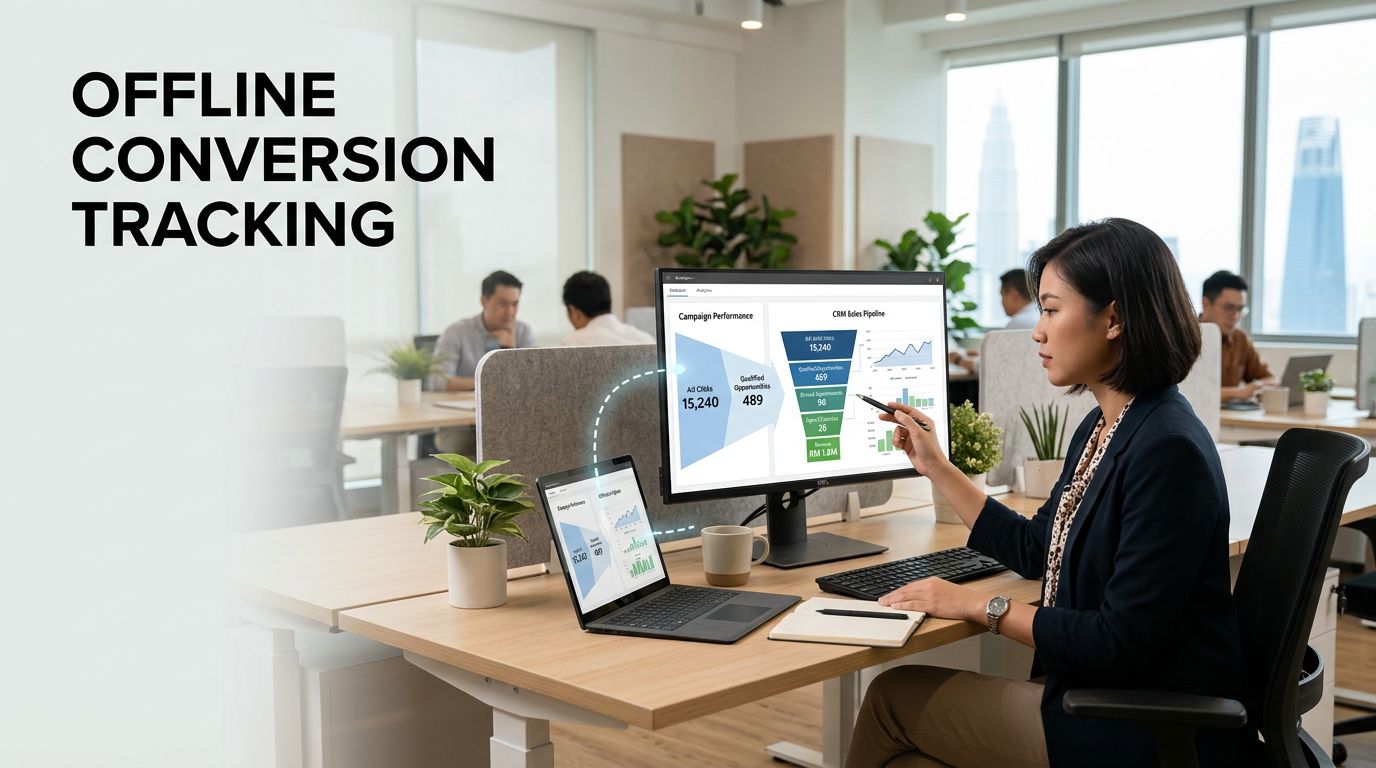
A Google Ads lead isn’t revenue. A form submission, phone call, or WhatsApp enquiry supports lead generation. Revenue comes from qualified opportunities and closed sales, revealing the cost per closed sale.
Offline conversion tracking Malaysia connects ad clicks with those later CRM outcomes. It shows which campaigns produce booked appointments, signed contracts, paid invoices, and repeatable sales opportunities, not only cheap leads.
The first step is auto-tagging, which preserves the information connecting each real customer outcome to its original ad click.
Offline conversion tracking Malaysia: the direct answer
Offline conversion tracking captures a Google Click ID from an ad click, stores it with the CRM lead record, and uploads the final sales result to Google Ads. Google can then attribute a closed sale, completed application, or signed agreement to the campaign and keyword that generated the lead.
For Google Ads, the main identifier is the GCLID, or Google Click ID. Google assigns it to ad clicks when auto-tagging is active. Google’s offline conversion import guidance explains how that ID links a later offline action to the original paid click.
This matters for Malaysian businesses because sales cycle length can vary widely. A Kuala Lumpur renovation contractor may quote for weeks before a job is confirmed. A tuition centre may need several follow-ups before a parent enrols a child. Without CRM lead data returning to the platform, both businesses may optimise campaigns around enquiries that never become customers.
Set the conversion action around a meaningful commercial event, such as:
- A sales-qualified lead accepted by your team.
- A showroom appointment attended.
- Closed sales, paid bookings, deposits, or signed contracts.
Choosing a meaningful milestone gives you a clearer cost per closed sale than a raw enquiry can provide.
Why Google Ads can optimise for the wrong leads
Standard tracking often reports a successful form submission as a conversion. However, Google Ads cannot distinguish between unreachable, unsuitable, duplicate, and ready-to-buy leads.
As a result, Smart Bidding may shift spend towards campaigns that generate low-cost form fills. Those clicks look successful at the top of the funnel, yet they can produce a poor cost per closed sale. Meta Ads can face the same limitation when it receives submissions or messaging starts. Its Conversions API feed can instead return qualified outcomes.

Once you import qualified leads and closed sales, bidding receives stronger signals, and the attribution model reflects commercial outcomes. A campaign with fewer leads may then earn more budget because those leads consistently progress into revenue. Compare campaigns by cost per closed sale to judge commercial efficiency, not lead volume alone. Where deal values differ, add the actual revenue or agreed value in MYR to support value-based bidding.
Server-side tracking can improve data control, but it cannot connect a closed sale when the CRM lost the click ID at first contact.
GCLID import versus enhanced conversions for leads
Both methods send business outcomes back to Google Ads. They use different matching data, which can affect the match rate.
| Method | Data matched | Best fit |
|---|---|---|
| GCLID import | Google Click ID captured at the ad click | CRM workflows where a lead form captures the GCLID |
| enhanced conversions for leads | Consent-aware, hashed customer data | Leads that may return later through another device or channel |
A GCLID import is often the clearest starting point for offline conversion tracking in Malaysia. Auto-tagging captures the Google Click ID through a hidden form field. Use CRM integration to store it until the lead reaches the selected sales stage.
Where a GCLID is missing, enhanced conversions for leads can use consented email or phone data after normalisation and hashing. Capture both approaches where appropriate, but retain good CRM records and use a data manager for no-code validation or routing. Check record-level results for the match rate, lead quality, and cost per closed sale. If deal values differ, pass reliable revenue back for value-based bidding. The same signals can also reach Meta Ads through the Conversions API.
For ongoing imports, use the data manager or Google’s recommended connection. For automated uploads, review the Google Ads API requirements for offline conversions. Each record needs a click ID, conversion time with timezone, conversion action, value, and currency code.
Build the CRM connection before leads reach sales
A reliable CRM integration depends on data discipline as much as tracking code. Map how tags, forms, CRM fields, and sales stages connect before asking an agency or developer to install tools.
- Turn on Google Ads auto-tagging. Use Google Tag Manager to read the Google Click ID when a visitor arrives.
- Save it in a hidden form field and pass it into a dedicated CRM property. Also capture GBRAID and WBRAID where relevant.
- Keep the identifier with the lead through every status change, including contacted, qualified, quoted, won, and lost.
- Create a Google Ads offline conversion action for the CRM milestone that matters.
- Start with a CSV offline upload. Once proven, move to a scheduled import, a data manager, Zapier, HubSpot, Salesforce, or API automation. Businesses with a parallel paid-social workflow can connect Meta Ads through Conversions API or a webhook integration.
- Reconcile imported sales against CRM records each week. Review the match rate and cost per closed sale, then correct failed matches quickly.

Use one stable conversion name and a consistent timestamp format. A misspelled conversion name or a timestamp without the right timezone can stop valid sales from matching.
Identifier uploads have a limited upload window. Teams commonly work to a 90-day limit from the original ad click, so do not wait until quarter-end to export completed deals. If sales cycle length is long, upload qualified milestones before closed sales are available. Retain the final commercial outcome for management reporting.
WhatsApp lead tracking without losing attribution
WhatsApp is central to lead generation for many Malaysian SMEs. Yet visitors who open WhatsApp directly from an ad often leave the browser before a standard form can store the Google Click ID.
A more dependable route sends Google Ads traffic to a lightweight landing page first. The page captures the Google Click ID, creates a lead reference, and then opens WhatsApp. Your team or messaging automation must add that reference to the CRM record when the conversation begins. Test it on Android, iPhone, desktop WhatsApp, and in-app browsers.
Phone leads need a similar process, using call tracking or dynamic number insertion where your provider supports it. Pass the call record and lead source into the CRM, then check the match rate during reconciliation. Staff should select outcomes within a clear service-level timeframe. Reports should compare source quality by cost per closed sale, not only chats or answered calls. A good campaign cannot overcome a pipeline where calls remain unlogged for days.
For Meta Ads, send qualified CRM stages through its supported offline or Conversions API workflow only after checking consent, data protection requirements, and platform permissions. Have a data manager validate approved CRM-stage routing before activation. The goal is the same across platforms: optimise toward serious enquiries and sales, not message starts alone.
Protect customer data and keep reporting useful
Offline tracking may handle names, emails, phone numbers, quotation values, and sales notes. Under Malaysia’s PDPA, your data manager should review data protection, your privacy notice, consent wording, access controls, retention policy, and vendor agreements before sending approved fields to Google Ads or using Conversions API, with appropriate consent and controls in place.
Using hashed customer data can reduce exposure, but it does not remove privacy responsibilities. Server-side tracking improves collection control, but it does not replace click-ID preservation. Limit uploads to fields needed for matching, restrict CRM access, and avoid sending free-text notes or sensitive personal data.
Anonymised CRM outcomes can improve your wider search strategy and commercial reporting, including cost per closed sale. Lead themes reveal the questions that bring qualified visitors, which helps SEO Malaysia teams shape service pages, FAQs, semantic content, and local landing pages. An AI SEO Agency can use anonymised enquiry patterns to strengthen answer engine optimization, entity SEO, and content for AI-generated search answers.
The AI SEO Agency Malaysia businesses choose should report commercial lead quality alongside rankings and AI search visibility. A Trusted AI SEO Agency will explain how its AI SEO, AEO, GEO, and LLM optimization work connects to calls, enquiries, and sales. Explore PixelPro’s SEO services in Malaysia for a measurement-led approach to organic growth.
Key takeaways for Malaysian business owners
- Track a CRM milestone that sales teams recognise as valuable, not only a website form submission.
- Preserve the Google Click ID from landing page to closed-won record, then import outcomes frequently.
- Treat WhatsApp and call attribution as part of the CRM process, not a last-minute reporting task.
- Audit data quality and cost per closed sale before increasing Google Ads budgets or changing Smart Bidding targets.
Conclusion
Offline conversion tracking turns ad reporting into a view of real sales activity. It shows which campaigns, searches, and audiences lead to qualified opportunities and closed sales, rather than superficial conversion totals.
When source data remains attached to a real customer outcome, your attribution model becomes more defensible. Your sales team also has a clearer role in marketing performance.
FAQs
What should count as an offline conversion?
Choose an event that indicates real sales progress. For many businesses, this is a qualified lead, attended consultation, approved quotation, paid booking, or closed sale. Avoid importing every enquiry if many are irrelevant.
Can a business start with manual CSV uploads?
Yes. Manual uploads help validate CRM fields, conversion names, timestamps, and the match rate before automation. Use a defined upload window, because waiting too long to import records can delay reporting. Once records are consistent, a CRM connector, Zapier, or the Google Ads API can reduce manual work.
Does Google Analytics replace offline tracking?
No. Google Analytics explains website behaviour and on-site conversions. Google Ads reporting can then include CRM outcomes after the lead, such as sales qualification and revenue results.
Can the same CRM outcomes be used for Meta Ads?
Yes, if the CRM records consistent event names and timestamps. A Conversions API setup can send qualified lead and revenue outcomes back for campaign measurement and optimisation.
How can PixelPro help review lead tracking?
If your business needs clearer reporting across SEO, CRM leads, calls, and WhatsApp enquiries, speak with an SEO consultant about a practical website and conversion tracking review.
