

When two pages on your website target the same Google search query and share identical buyer intent, they often trigger keyword cannibalization. This conflict can lead to fluctuating search engine rankings, where your pages compete against one another instead of gaining authority. As these pages split your clicks, the wrong content may attract visitors, ultimately threatening your organic traffic and overall visibility.
For Malaysian SMEs, this issue frequently emerges after months or years of adding service pages, blog posts, city pages, and ad landing pages without a clear content strategy. Addressing keyword cannibalization requires a structured approach to ensure each page serves a distinct purpose. Most effective keyword cannibalization fixes come down to one simple rule: give each page one primary objective, then ensure every other page exists solely to support it.
Key Takeaways
- Consolidate for Authority: When multiple pages target the same intent, merge them into one authoritative piece of content and use 301 redirects to preserve backlinks and ranking power.
- Define Unique Intent: Differentiate your pages by mapping them to specific user needs—such as commercial service pages for high-intent queries versus educational blog posts for long-tail research.
- Audit Internal Signals: Regularly review your internal linking anchor text to ensure you aren’t sending conflicting signals to search engines about which page should rank for a primary keyword.
- Avoid Duplicate Local Pages: For location-based SEO, ensure each city page offers unique value, such as local case studies or area-specific details, rather than simply swapping town names in identical templates.
What this problem looks like on a real SME website
Keyword cannibalization occurs when multiple pages on your site compete for the same search query. Instead of sending one strong, authoritative signal to Google, your site splits its focus across multiple URLs. This confusion often leads to diluted ranking signals, forcing the search engine to guess which page is the most relevant.
Because of this competition, that guess often changes. One week, your service page ranks. The next week, an older blog post appears in its place. In other cases, neither page achieves strong search engine rankings because the content is too similar.
A Kuala Lumpur accounting firm might have a homepage, a tax service page, and a blog post about tax help for SMEs, all tuned too closely to the same commercial phrase. A Selangor contractor might publish five city pages with nearly identical copy, hoping to rank in more places. Both cases trigger keyword cannibalization, as multiple URLs struggle to gain traction.
Not every similarity is a problem. A service page and an educational article can both mention the same topic if the search intent is different. One page can target users ready to hire a service, while another can address the search intent of someone looking for information on how a process works.
The warning signs are usually clear:
- Search engine rankings swap between two or more pages.
- A blog post ranks for a service query instead of the service page.
- Search impressions are spread across similar URLs.
- Title tags, H1s, and page summaries sound almost identical.
- Internal links point the same anchor text to different URLs.
When that happens, the issue is not only about search visibility. It also negatively impacts the user experience, as potential leads may land on a page that fails to provide the specific solution they need, ultimately hurting your enquiries, bookings, and sales.
Where overlap usually starts on SME websites
Most SME sites do not create keyword cannibalization on purpose. It grows quietly when the site expands and nobody reviews the specific role of each page.
The common patterns look like this:
| Overlapping pages | Why they clash | Better fix |
|---|---|---|
| Homepage and service page | Both chase the same broad commercial term | Keep homepage broad, let the service page own the service intent |
| Service page and blog post | The blog sounds like a sales page | Rework the blog for informational search intent or merge it |
| Two location pages | Only the city name changes | Rewrite with unique local value or consolidate |
| Old and new service pages | A redesign left the old URL live | Merge the best content and 301 redirect |
| SEO page and PPC landing page | The ad page is indexed and mirrors the main page | Keep one main organic page, then use canonical control or keep the ad page out of search |
Local SEO makes this even more sensitive. A page for “dentist in Petaling Jaya” and a page for “dentist in Subang Jaya” can both exist, but only if each page offers real local value. That includes area-specific copy, nearby landmarks, actual service coverage, local proof, and content that targets specific long-tail keywords relevant to what people in that area need.
If every location page uses the same paragraph with a different town name, Google identifies this as duplicate content and sees weak differentiation. Your Google Business Profile categories and listed service areas should also line up with the local pages you want to rank.
Additionally, be mindful of how your site architecture impacts your domain authority. Homepage clashes are common because many SMEs try to make the homepage rank for every service and every city. That usually blurs the purpose of your primary landing page. A stronger homepage SEO plan for local leads separates broad brand searches from service and city-level searches that are better served by targeting unique long-tail keywords on dedicated pages.
How to find the right page before you change anything
Don’t start by deleting pages. First, identify your preferred page and decide which URL should win the battle against keyword cannibalization.
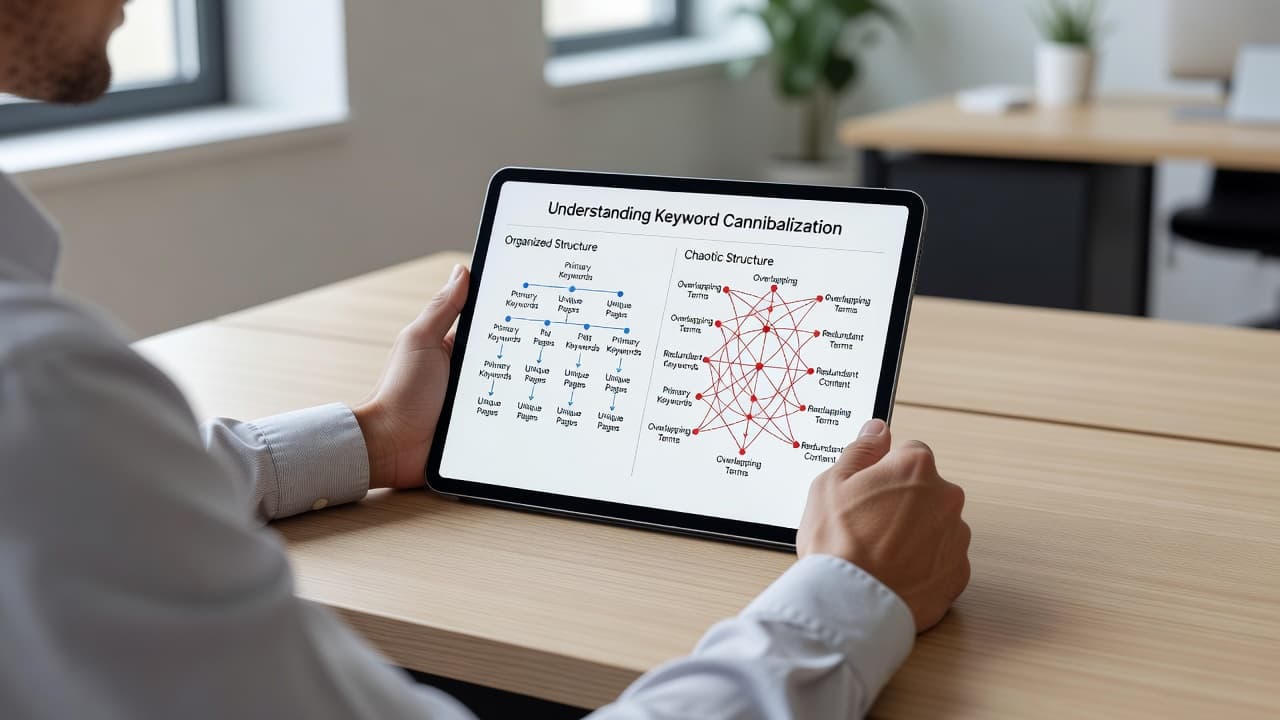
Start your investigation with Google Search Console. You should use Google Search Console to compare your performance reports and identify if a single search query triggers multiple URLs. Another effective method is to use a site search operator, such as site:yourdomain.com yourkeyword, to see exactly how many pages Google associates with that topic. Once you gather this data, review titles, H1s, meta descriptions, and internal anchor text, as similar wording often exposes keyword cannibalization faster than rankings alone.
A simple content audit process works well:
- Use Google Search Console to list every page appearing for the same query or topic.
- Check what each page is asking the visitor to do, such as call, book, compare, or learn.
- Review conversions, backlinks, internal links, and content depth.
- Evaluate the search intent to choose the page that best fits your specific business goal.
That last step matters most. The best ranking page is not always the best page for your business. An old article may rank in Google Search Console, but if it doesn’t move people toward an enquiry, it should not be the main commercial page.
WordPress plugins can flag duplicate titles, but they cannot decide intent for you. That judgment requires business context. If the data feels messy, an SEO audit and strategy review can sort pages by search intent, site structure, lead value, and technical issues. By regularly checking Google Search Console and conducting a thorough content audit, you ensure your site architecture remains clear and effective. For a second reference, Semrush’s cannibalization guide gives a useful overview of common patterns.
The keyword cannibalization fixes that usually work
If two pages chase the same customer action, choose one winner and make the rest support it.
Merge overlapping pages and redirect the weaker one
When two pages answer the same search intent, content consolidation is often the most effective way to resolve keyword cannibalization. Keep the stronger URL, combine the high-quality elements of both pages, and then implement 301 redirects from the weaker page to the preferred destination.
This approach works well for aging service pages or duplicate blog posts, as 301 redirects allow you to preserve existing backlinks that point to the retired page. This process helps transfer authority to your primary URL, effectively boosting your search engine rankings. After you apply 301 redirects, update your internal links, XML sitemap entries, and any menu links to ensure your site structure remains clean.
Re-optimize pages that should stay separate
Sometimes both pages deserve to remain live. A service page and a blog article can work together if their roles are distinct.
The service page should focus on commercial intent by showcasing proof and clear calls to action. The blog post should answer supporting questions, such as cost comparisons or industry mistakes. By adjusting your titles and headings, you differentiate the intent, which helps prevent keyword cannibalization and improves overall organic performance. This strategy is vital for local businesses, as it allows your core service page to rank for primary terms while your blog captures long-tail traffic that earns relevant backlinks over time.
Clean up internal linking signals
Poor internal linking often keeps search confusion alive. If half of your site directs the phrase “web design KL” to a blog post and the other half directs it to a service page, Google receives mixed signals.
Point your strongest anchor text toward the page you want to rank for the core term. Use descriptive, varied anchor text for your supporting pages to provide clear context. Review your footer links, related-post widgets, and older articles to ensure your internal linking structure supports your primary SEO goals rather than conflicting with them.
Use canonical tags and site structure
Canonical tags help when near-duplicate pages must stay live, such as printer-friendly URLs or specific campaign pages. While canonical tags are useful for technical duplication, they are not a substitute for proper content consolidation.
PPC landing pages require specific care. If an ad page mirrors your main service page, use canonical tags to keep the paid page out of the search index to avoid keyword cannibalization. Properly managing these elements ensures that search engines can easily identify your most authoritative content. Clear page ownership helps search engines and AI tools prioritize the right URL, which ultimately leads to more stable search engine rankings and better long-term visibility.
A simple decision framework before you publish or prune
When two pages overlap, use this short filter before you make changes to address keyword cannibalization:
- Do both pages target the same search intent and the same next step?
- Which page drives better enquiries, calls, bookings, or sales?
- Can one page absorb the useful content from the other to improve the overall user experience?
- If both pages stay live, can a reader explain the difference in one sentence?
- Have you updated redirects, internal links, titles, and canonicals after the change?
Common mistakes are easy to avoid once you know them. Do not delete a page without a redirect if it has traffic or valuable backlinks. Avoid the trap of creating duplicate content by cloning city pages with only place names swapped. Do not leave two pages with near-identical titles and expect Google to sort it out. Also, do not publish PPC landing pages into the index by accident if they mirror your main offer page, as this creates duplicate content that can harm your rankings.
Always perform a content audit before deciding whether to prune or merge. Track the result after every fix to protect your organic performance. Rankings can move for a few weeks, so watch impressions, clicks, conversions, and lead quality to ensure your organic traffic remains stable before making another round of changes. PixelPro often handles this kind of cleanup inside broader SEO strategy, technical SEO, content planning, local SEO, analytics tracking, paid campaign support, and website optimisation for Malaysian businesses.
Frequently Asked Questions
Does keyword cannibalization always mean I have to delete pages?
No, you do not always need to delete content. In many cases, you can re-optimize the titles and content of the competing pages to target slightly different keywords or distinct user intents. Deletion is usually reserved for low-quality or redundant pages that provide no unique value to your site.
How long does it take for search rankings to recover after fixing cannibalization?
It typically takes a few weeks for Google to recrawl your site and recognize the structural changes you have made. During this period, you may see some fluctuations in ranking, but you should monitor your impressions and click-through rates to ensure the consolidated page eventually gains more stability.
Can having two pages about the same topic actually be good for SEO?
Yes, it can be beneficial if the pages serve different purposes. For example, a service page optimized for conversion works well alongside a detailed blog post that answers informational questions about the same topic, provided the content and internal linking clearly distinguish the role of each page.
Final thoughts
One clear page with one clear purpose will usually beat several similar pages that compete with each other. When your site maps each topic to the right intent, Google understands your content better, visitors reach the right next step faster, and your search engine rankings improve.
If your website has repeated service pages, copied location pages, or ad landers competing with organic pages, you should address keyword cannibalization and fix the page map before you publish more content. Resolving these overlapping issues is often the most effective way to strengthen your site structure and boost overall performance.
If you would like a second opinion, PixelPro can help you request an SEO review and discuss a practical plan to improve search visibility, site structure, and lead quality.
