
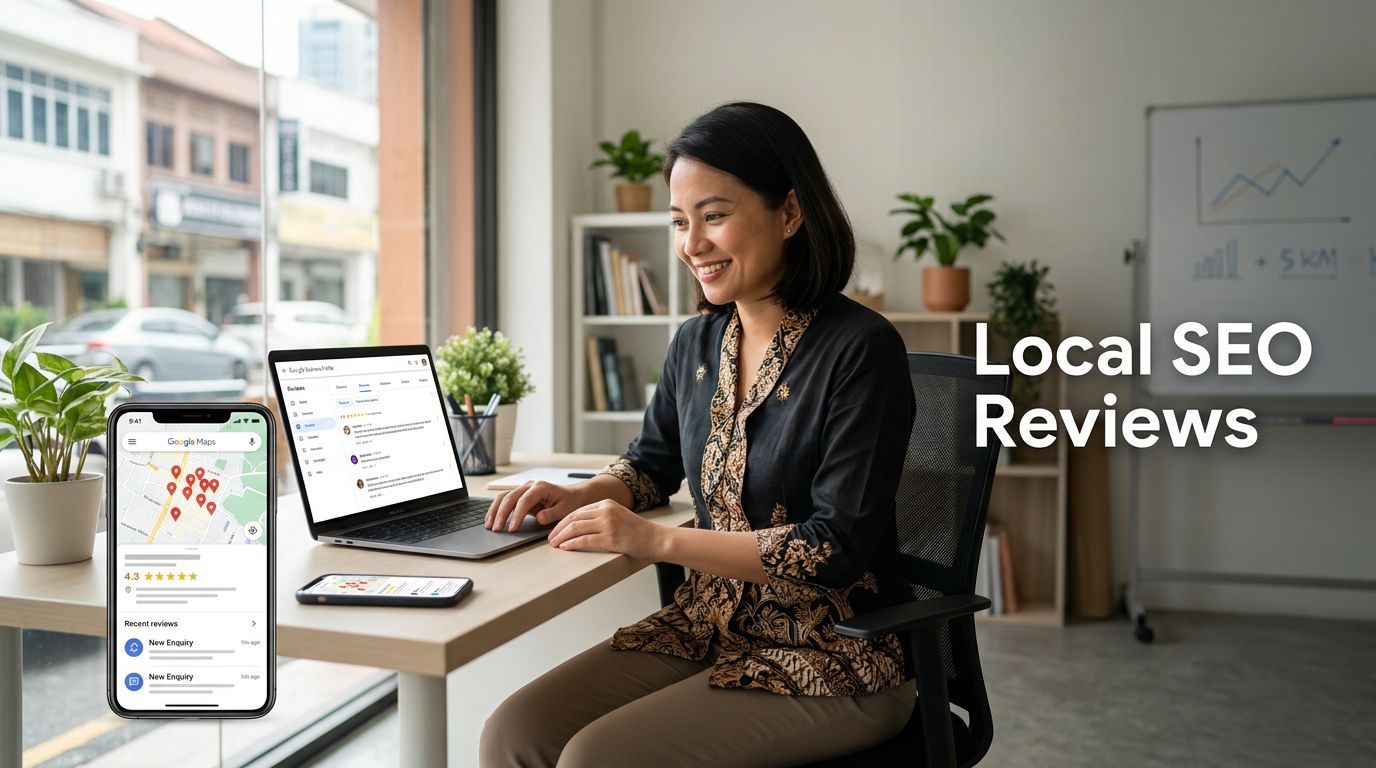
A customer may decide whether to call your business before they ever visit your website. They scan ratings, recent comments, photos, and your replies while comparing options on Google Maps.
For Malaysian service providers, local SEO reviews are public proof that your business delivers on its promises. A steady, honest review process can support map visibility, build trust, and help turn searches into calls, WhatsApp enquiries, bookings, and sales.
The aim is not to chase five-star praise. It is to make genuine local business reviews easy to find and useful to future customers.
Direct answer: how reviews support growth
Reviews can improve your visibility and conversion rate when they are genuine, recent, detailed, and attached to an accurate Google Business Profile. They help customers assess service quality. Google may also consider review signals alongside relevance, distance, profile accuracy, and wider prominence within broader local ranking factors.
A sound strategy combines review requests with good service delivery, prompt replies, and website content that answers the same questions customers raise in their feedback.
Key takeaways
- Ask every eligible customer for an honest review after a completed service, rather than selecting only happy customers.
- Keep your profile details, service areas, phone number, photos, and business categories accurate so reviews support a clear local entity.
- Use recurring feedback to improve operations and service pages, not to manufacture keyword-heavy review text.
Reviews are one part of local search performance. They cannot compensate for an incomplete profile, poor service experience, or a website that gives customers little reason to contact you.
How reviews influence maps and AI search
A Google Business Profile can appear in search engine results and the local pack before a customer clicks through. Its local business reviews, rating pattern, review recency, and comment detail shape its credibility. These signals affect how convincing the listing appears beside nearby alternatives.

Reviews reduce uncertainty for local customers
Someone seeking an air-conditioning contractor in Shah Alam or a tuition centre in Kuala Lumpur wants evidence that the business answers calls, arrives on time, and handles problems well. Clear feedback reduces that uncertainty.
Review wording is user-generated content that can provide context about services, places, and customer needs. A review that mentions “same-day aircon servicing in Subang Jaya” offers more useful context than a row of generic five-star ratings. Never script these phrases, however. Customers should use their own words.
Ratings matter, but patterns matter more
No star-rating threshold guarantees placement in a map result or an AI-generated recommendation. Rating patterns and recurring themes clarify customer sentiment, while poor ratings, unanswered complaints, or old feedback may send customers elsewhere.
A credible profile usually includes detailed feedback, thoughtful business replies, and recent activity. Review velocity means a steady flow of genuine reviews, not a sudden spike. A perfect rating with vague, repetitive reviews can look less convincing than a strong rating with professionally handled complaints.
Set review targets by local competition
Google does not publish a minimum review quantity that guarantees placement in local search rankings. A new clinic in Petaling Jaya and a long-established hotel in Melaka should not use the same target.
Instead, compare your profile with local competitors appearing in the local pack for your core service and service area. Look at total reviews, review recency, average star rating, photos, and the quality of their replies.
| Business situation | What to compare | Practical next action |
|---|---|---|
| New home-service business | The map results for its main service and town | Ask every completed customer for feedback |
| Established Kuala Lumpur firm | Review freshness among close competitors | Add review requests to the service-completion process |
| Multi-branch provider | Performance for each branch, not the brand total | Track reviews, sentiment, and response time by location |
Prioritise consistency over arbitrary quotas
Some businesses set targets such as a certain number of reviews each month. That can help with planning, but staff should never pressure customers or treat reviews as a quota.
A better measure is coverage, with review velocity showing the pace of genuine incoming reviews. If your Selangor contractor completes 40 eligible jobs in a month, did every customer receive the same polite opportunity to leave feedback? That reveals customer sentiment and turns local SEO reviews into a reliable business process rather than a last-minute marketing task.
Request reviews without damaging trust
A trustworthy review acquisition strategy asks soon after the customer has experienced the result. For a renovation contractor, that may be after handover. For an accountant, it may be after a completed filing. For a restaurant, it may be after a confirmed reservation or delivery.

Make the request simple and personal
Send one short follow-up through the customer’s normal channel, such as WhatsApp, email, or SMS. Include the relevant direct review link for the review platforms they use.
A suitable message is: “Thank you for choosing us. If you have a moment, we would appreciate an honest review of your experience.” The customer should use their own phone and have space to decide without pressure.
Consistent, non-pressured requests can support steady review velocity without turning reviews into a quota.
Avoid review gating and incentives
Do not send review links only to customers who say they are satisfied. That practice, known as review gating, creates a misleading picture of customer sentiment.
Google’s content policy for Maps contributions requires reviews to reflect genuine experiences. Avoid discounts, gifts, loyalty points, staff-name requests, pre-written wording, shared in-store devices, or requests for a specific rating. The same rule applies to reviews from employees, relatives, suppliers, and other people with a conflict of interest.
Respond to every review with care
Thoughtful review responses to local business reviews show prospective customers how your business behaves after service completion. They also provide a structured view of customer sentiment and recurring issues, such as late arrival times, unclear quotations, or slow follow-up.
Thank positive reviewers without repeating yourself
Use the customer’s first name only if it is already public in the review. Refer to a real aspect of the service without revealing private details.
For example, a legal firm can thank a client for recognising clear communication. A pest-control company can acknowledge feedback about punctuality. Short, individual replies sound more credible than copied templates.
Handle negative reviews as a service-recovery task
Treat complaint handling as a service-recovery task within review management, not a public argument. Respond calmly, acknowledge the concern, and offer an appropriate offline channel to investigate. Do not argue about events in public or disclose account details, addresses, health information, or other private facts.
A 24-hour reply target can improve customer recovery, but Google has not confirmed response speed as a stand-alone local ranking factor.
If a review clearly violates policy, flag it through the correct process. Businesses cannot remove reviews themselves. Google’s guidance explains how to report inappropriate Business Profile reviews.
Turn customer feedback into AI-search-ready content
Review text is user-generated content that should inform your marketing, not replace it. If customers repeatedly praise fast WhatsApp replies, transparent pricing, or experience with condominium management offices, use those genuine themes on service pages and FAQs. They can improve keyword relevance without scripting or copying reviews.
Build pages around genuine customer questions
AI SEO helps a website answer detailed questions in Google, AI tools, and answer engines. Clear pages help a business be understood and surfaced in ai search results, while supporting discovery through organic search results. A plumbing firm might answer questions about emergency call-outs, service areas, inspection steps, and quotation timing. A B2B software provider can explain onboarding, integrations, data security, and support terms.
Google’s guidance on AI features makes clear that the basics still apply: helpful original information on accessible, indexable pages. Clear page structure, descriptive headings, internal links, structured data, accurate business information, and local search optimization matter more than chasing AI mentions.
Strengthen entity signals across channels
Entity SEO connects the same business facts across your website, Google Business Profile, directories, and social channels. Keep your business name, address, phone number, operating hours, service areas, and primary services consistent.
Monitor relevant public conversations on review platforms, including Facebook, Instagram, TikTok, and local forums. These platforms can reveal questions or objections that people may not post on Google. Share approved review excerpts only with permission, and never copy them into places where they appear as new customer reviews. These signals can guide content, but AI visibility can’t be guaranteed.
For service firms, Answer Engine Optimization services can connect clear local pages, FAQs, schema, and reputation signals into a practical answer-focused content plan.
Measure reviews against real business outcomes
A rising review count is useful, but it is not the final measure. Track whether stronger reputation signals lead to more calls, direction requests, website clicks, a higher click-through rate, form submissions, bookings, and qualified WhatsApp enquiries.
Use a simple monthly review dashboard
Review each location separately. If your business operates across multiple locations or channels, compare activity across the review platforms it actively monitors.
Record total review count, new genuine reviews, review velocity, review recency, average rating, recurring praise, recurring complaints, and median reply time. Summarise those themes consistently to track customer sentiment.
Then compare those signals with Google Business Profile actions, Google Search Console impressions for local service queries, and GA4 website conversions. Look for correlations over several months, and don’t treat one busy week as proof of causation or a ranking change.
Improve the service behind the feedback
Feedback often exposes conversion problems that analytics cannot explain. If multiple customers mention delayed quotations, the issue may be internal follow-up rather than SEO. If reviewers praise a specialist service that is barely mentioned online, build a dedicated page around that offer.
Google’s generative AI optimisation guidance also supports this approach: publish useful content that people can access, understand, and trust.
What a Trusted AI SEO Agency Checks First
A capable AI SEO Agency starts with the business fundamentals. It reviews your Google Business Profile, online reputation, review process, local landing pages, technical crawlability, conversion paths, and consistent business information across the web.
For businesses searching for an AI SEO Agency Malaysia can trust, look for transparent reporting and realistic advice. A sound SEO Malaysia strategy connects local search visibility with enquiries, bookings, and sales instead of reporting rankings alone.
Useful agency work includes Google Business Profile optimisation, review-monitoring workflows, content improvements, local schema, and a plan for generative search visibility. It should also explain how GEO helps AI systems understand your services and locations, without promising citations or instant placement.
Turn Better Service Into Stronger Local Proof
The strongest review strategy starts with work worth recommending. Ask consistently, make it easy for customers to respond, treat criticism respectfully, and use feedback to improve your service and website.
Over time, honest customer feedback shows how your business solves real problems. That proof can build confidence across Google Maps, organic search, and AI-assisted discovery.
If you want a practical review of your local visibility, website structure, and AI-search readiness, speak with an SEO consultant about a plan that fits your business goals.
Frequently Asked Questions
How many reviews does a Malaysian service business need?
There is no universal number. Compare your profile with nearby competitors offering the same service, then focus on receiving genuine, recent feedback from completed customers. A steady process is more useful than a sudden spike of reviews.
What is review velocity, and should a business set a target?
Review velocity is the pace of genuine reviews over time. Aim for consistent requests after completed jobs, not quotas or incentives.
Do negative reviews harm local search visibility?
A negative review does not automatically damage rankings. However, repeated complaints about the same issue can reduce customer trust. Reply professionally, investigate the problem, and fix the operational cause where possible.
Can local reviews help with AI search visibility?
Reviews can provide supporting trust and service context, but they don’t replace a useful website. Clear service pages, accurate location details, FAQs, technical SEO, and consistent brand information give AI-driven search systems better information to retrieve and reference.
