
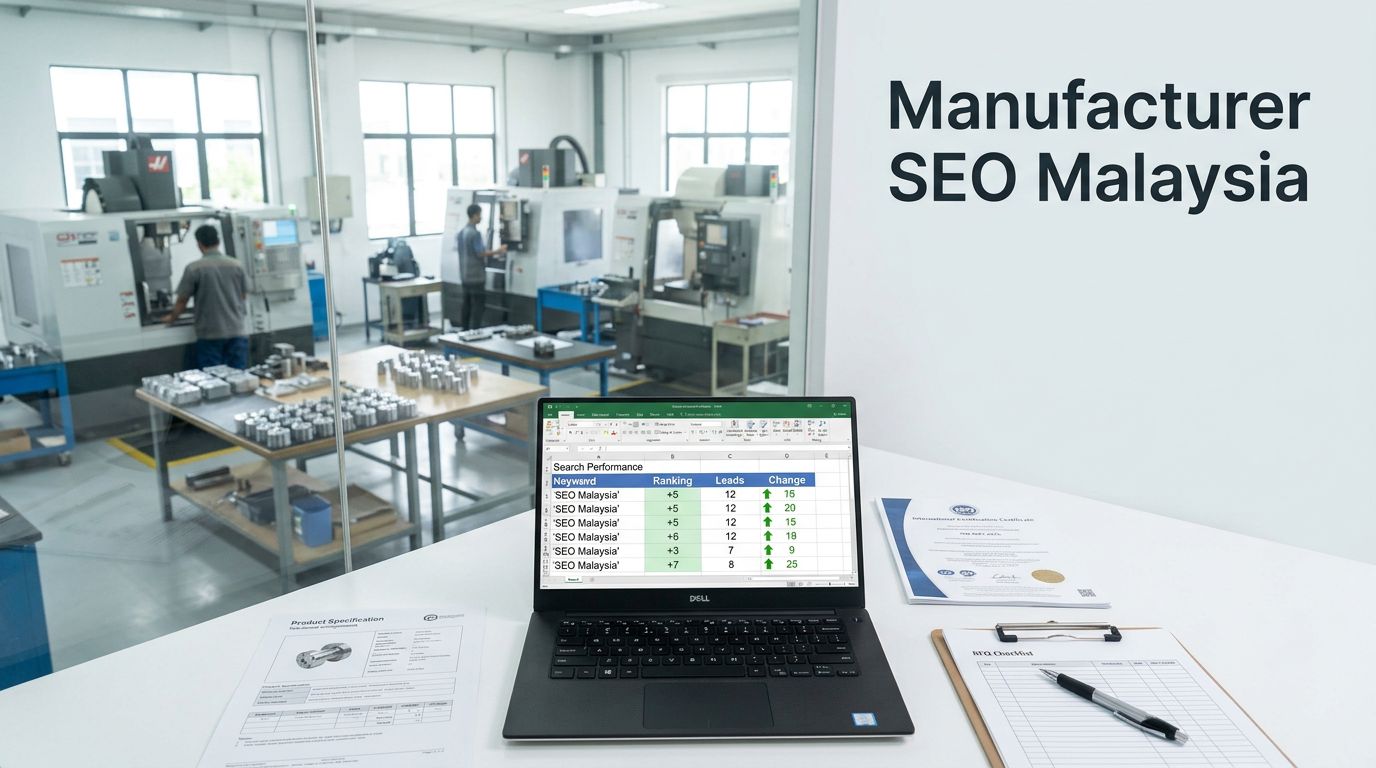
A procurement manager rarely searches for a supplier once and sends an order straight away. They compare capabilities, materials, certifications, lead times, and technical fit before deciding whether a supplier is ready for an RFQ.
That is why manufacturer SEO Malaysia must make those details easy to find. Your website should help engineers, buyers, and project managers confirm your technical capabilities and request a quotation with confidence.
A strong plan connects search visibility with useful product information, credible proof, and enquiry paths that fit a longer B2B buying process.
The direct answer: SEO for Malaysian manufacturers
Manufacturer SEO in Malaysia helps industrial businesses appear when B2B buyers search for products, processes, contract manufacturing, and supplier capabilities. It combines Technical SEO, commercial content, product-page improvements, and authority building.
Organic traffic isn’t the goal by itself. A good strategy supports enquiries, RFQs, phone calls, WhatsApp leads, and plant visits. It also creates qualified sales opportunities with buyers who already need what you make.
For example, a Penang precision-machining company may want visibility for searches about tight-tolerance CNC parts. A Selangor packaging manufacturer may need pages that explain food-grade materials, custom dimensions, minimum order quantities, and turnaround times.
Key takeaways
- Build pages around the problems and specifications buyers use during research.
- Fix crawlability, duplication, speed, and weak internal links before adding large amounts of content.
- Treat AI visibility as an extension of sound SEO, not a replacement for it.
- Measure qualified enquiries and sales opportunities alongside rankings and organic visits.
A manufacturer can rank for a broad product term yet still lose enquiries when buyers can’t find capability details, proof, or an easy RFQ route.
Why industrial buyers search differently
B2B manufacturing searches are often technical, narrow, and deliberate. A buyer may begin with a broad phrase, then refine it by material grade, process, tolerance, industry application, location, or certification requirement.
Retail-style pages often focus on price and quick checkout. Manufacturing websites need to reduce perceived supplier risk. They should answer the questions sales teams hear during qualification calls.

B2B research happens across several visits
A plant manager might first look for “plastic injection moulding Malaysia.” Later, they may search for “automotive-grade injection moulding supplier” or review a specific manufacturer’s quality process.
Because the decision takes time, your content should support each stage. Capability pages build awareness. Technical guides help comparison. Case studies, certifications, and clear contact details help buyers shortlist suppliers.
This is where SEO services Malaysia can offer a more focused approach than a generic digital marketing campaign. It starts with questions that lead to commercially useful conversations, rather than chasing broad traffic.
Map keywords to the buyer’s buying stage
Keyword research for a manufacturer should reveal intent, not produce a long list of phrases to repeat. Group searches by the next decision a buyer needs to make, then create or improve the page that answers it.
A supplier of fabricated metal components, for instance, should separate general process searches from searches for a specific industry or part requirement.
| Buyer stage | Search intent | Useful page type |
|---|---|---|
| Early research | Understand a process or material | Educational guide or process overview |
| Supplier comparison | Assess capabilities and quality | Capability page with equipment and proof |
| Technical validation | Confirm dimensions, grades, or tolerances | Product specification page or FAQ |
| Contact decision | Request a quote or speak to sales | RFQ page with clear next steps |
Start with commercial problems, not vague volume
High-volume terms can look attractive in a keyword tool. Yet a phrase such as “manufacturing company Malaysia” may draw job seekers, students, investors, and buyers from unrelated sectors.
Prioritise terms that show a clear fit. These may include a process plus material, a product plus industry, or an application plus location. “Stainless steel food processing conveyor fabricator” has less volume than a broad machinery query, but it can bring a far better prospect.
Also review internal site-search data, sales emails, quotation requests, and trade-show questions. These sources often reveal the language buyers use before they become leads.
Create a connected topic structure
One page cannot credibly explain every process, product, and market. Build a logical On-page SEO structure that connects capability pages with materials, applications, and FAQs:
- A main service page can introduce a production capability and its typical applications.
- Supporting pages can address materials, production methods, finishes, tolerances, and industry requirements.
- A practical FAQ can answer common buying questions before a visitor needs to email sales.
This structure gives readers a clear path through related information. It also helps search systems understand the relationship between your expertise, services, and evidence.
Build product pages procurement teams can use
A product page should function as an On-page SEO asset, not just display a photo and short description. Buyers need details that help them decide whether to request a quotation.
Include the material options, manufacturing process, dimensional range, finishing choices, applicable industries, production capacity where appropriate, quality checks, and a clear enquiry route. Only publish claims your business can substantiate.
Compress product and facility images without reducing useful detail. Monitor Core Web Vitals so the page remains fast and usable as well as informative.
Put proof beside each capability
A page for custom cable assemblies should state what types of assemblies you produce and where they are used. It shouldn’t make unsupported claims about serving every industry or meeting standards your company doesn’t hold.
Helpful proof may include genuine facility photographs, equipment information, inspection processes, named certifications, downloadable data sheets, or documented project outcomes where confidentiality allows. Keep each proof point beside the capability it supports.
Use descriptive Heading tags, such as “Materials,” “Testing,” “MOQ,” and “Lead Times.” They help busy visitors scan for their immediate concern.
Google’s introduction to structured data explains how Schema markup helps search engines understand page content. Use valid structured data when it accurately describes a product, organisation, FAQ, or service. Schema markup, certifications, and product claims don’t replace visible evidence or substantiated claims. The markup should match information a human can see on the page.
Technical SEO keeps your catalogue discoverable
Technical SEO makes it easier for search engines to crawl, render, index, and understand industrial websites. Check Core Web Vitals during rendering tests when scripts or large assets may slow key pages. This work is particularly important for manufacturers with large catalogues, PDF-heavy resources, older websites, or pages created by several departments over time.
Google’s SEO Starter Guide covers the core principles behind making content accessible and understandable in Search.
Control duplicate and low-value pages
Filtering systems, product variations, archive pages, and parameter URLs can create multiple versions of near-identical content. Search engines may then spend time crawling pages that add little value.
Review index coverage, canonical tags, XML sitemaps, redirect chains, broken links, and pages blocked by robots directives. Check catalogue templates for accurate Meta descriptions, clear Heading tags, and content that loads properly. Meta descriptions should accurately describe each product or capability page in search snippets. Heading tags should establish a clear hierarchy for buyers and search engines.
Large, multi-site, multilingual, or high-SKU manufacturers may need Enterprise SEO to coordinate templates and indexation rules. Also check whether important product or capability pages rely on scripts that stop key content from loading properly.
A regular SEO audit checklist for Malaysia supports a practical Website audit and helps identify issues before they weaken visibility across an expanding site.
Improve the path from page to enquiry
Mobile usability matters because buyers often research between meetings or while visiting a site. Monitor Core Web Vitals after template or image changes, since slower pages can interrupt research and enquiry completion.
Conversion rate optimization means reducing friction in the RFQ journey. Expose the correct contact route, phone number, email address, WhatsApp option, and necessary form fields.
Internal links should connect process pages to relevant materials, applications, and product pages. A visitor reading about powder coating may also need a route to fabricated enclosures or corrosion-resistance guidance. These links support both user research and page discovery.
Earn authority with evidence, not empty link building
Backlinks are one part of Off-page SEO and can help search engines recognise references beyond your own domain. However, a manufacturing business doesn’t need a large pile of irrelevant directory listings.
Industry association profiles, supplier partnerships, credible trade publications, technical interviews, university collaborations, and genuine project coverage can create stronger signals. Backlinks from relevant sources can strengthen credibility when the referring source is topical, editorially legitimate, and useful to procurement teams.
Publish resources people can cite
Original resources give other sites a reason to mention your company. Content marketing for manufacturers can include a material-selection guide, process comparison, maintenance checklist, or well-researched industry FAQ. These resources can be more useful than another promotional company profile.
Keep those resources accurate and maintained. If an article explains a production process, involve the engineer or operations lead who understands the constraints. Their knowledge often separates a helpful technical page from generic content.
For a Malaysian manufacturer, Off-page SEO should support reputation as well as rankings. A buyer who finds credible third-party references may feel more confident contacting your team.
Generative Engine Optimisation, AEO, and GEO for manufacturing websites
AI SEO improves your site’s ability to appear when buyers use Google, AI search interfaces, answer engines, or AI-assisted tools to compare providers. It still depends on Technical SEO, On-page SEO, accessible pages, useful information, factual accuracy, and a well-defined brand presence.
Google’s guidance on AI features and websites states that the same foundational SEO practices remain relevant for Google AI Overviews and other AI features in Search. There is no shortcut that replaces proper technical and content work.

Answer Engine Optimisation makes information easier to use
Answer Engine Optimisation, or AEO, focuses on direct, well-supported answers to real buyer questions. For AI search, a manufacturer can place concise, answer-ready information near the top of a page, followed by deeper technical details.
For instance, an industrial coating page could clearly explain suitable substrates, available finishes, operating conditions, and the information needed for a quotation. FAQs should answer actual buyer questions, not repeat the same sales message in several forms.
A practical comparison of SEO and Answer Engine Optimization can help teams decide where answer-focused content belongs in their wider plan.
GEO and entity clarity support generative search visibility
Generative Engine Optimisation, or GEO, focuses on helping generative systems understand a company’s identity, expertise, services, locations, and supporting evidence. For AI search, clear entity details and consistent facts across the website, business listings, industry directories, and trusted publications can reduce conflicting signals.
Use clear entity details, including your legal business name, core capabilities, operating areas, certifications, and specialist sectors. Link related pages so context stays connected.
Google’s generative AI optimisation guide advises site owners to keep creating unique, satisfying content for people. This aligns with the foundations of generative search optimisation in Malaysia.
Build local and export visibility with intent
A manufacturer may supply nationwide, serve a particular industrial corridor, or export to overseas buyers. Local SEO can support location-based visibility when pages add real value, such as regional logistics details, local facilities, named sectors, or genuine service coverage.
Avoid cloning one page for Kuala Lumpur, Johor Bahru, Penang, and every other city with only the place name changed. Thin location pages add little buyer value and can create duplication problems.
Keep local trust signals accurate
Maintain a complete Google Business Profile only if customers visit an eligible office, showroom, or factory. Local SEO also depends on consistent business details across your website and relevant directories. Add real location information, photographs, directions, and contact routes where useful.
For export-focused pages, explain your markets, shipping process, documentation support, or export experience only if your business provides it. The same principle applies to language versions. Create them for real audiences and maintain them properly.
Measure SEO by qualified pipeline outcomes
Search engine rankings and Organic traffic show visibility, but neither proves commercial value. Track whether they produce RFQs, calls, downloadable catalogue requests, WhatsApp conversations, booked meetings, and measurable CRM outcomes.
Connect Google Search Console and Google Analytics with a CRM or lead-tracking process where possible. Sales staff can then record which enquiries became qualified opportunities, quotations, or repeat business.

Expect progress to build over time
Technical improvements can make a site easier to crawl soon after deployment. However, useful content, earned references, and trust often take several months to influence meaningful organic performance.
Long sales cycles add another delay. A prospect may discover your site today but request a quotation much later. After technical changes, review indexed pages, impressions, engaged visits, Core Web Vitals, and relevant enquiries while tracking closed revenue over a longer period.
Scope determines monthly investment
Monthly SEO packages vary because manufacturers have different catalogue sizes, product ranges, technical issues, languages, export markets, and content gaps. A company with 20 focused capability pages needs a different plan from a supplier with thousands of product SKUs.
E-commerce SEO fits manufacturers with genuine online ordering or transactional catalogues. Don’t force retail SEO tactics onto a quotation-led B2B site.
Ask for a clear scope that explains audit work, priority pages, content production, technical fixes, reporting, and accountability. Cheap packages that promise a fixed number of links or articles without explaining quality often create more risk than value.
Choose an AI SEO agency that understands B2B sales
An AI SEO agency should not use AI to justify publishing large volumes of unreviewed text. Manufacturers need subject-matter accuracy, clear commercial priorities, and reporting tied to lead quality.
Searches for SEO agency Malaysia and SEO company Malaysia often come from firms seeking stronger Google visibility and readiness for emerging search experiences. The right partner should connect SEO with wider digital marketing activity. It should keep qualified B2B leads central and involve sales, engineering, and operations in content approval.
Trust signals to look for before appointing a partner
A trusted AI SEO agency should begin with questions about your buyer profile, key product lines, margins, sales process, website limitations, and existing measurement. It should explain its methods in plain language.
Compare SEO packages by scope, deliverables, reporting, and accountability, not by a fixed number of articles or links. For a manufacturer with industry references and multiple locations, ask how the partner handles Off-page SEO and Local SEO.
Look for a documented audit, transparent reporting, realistic timelines, analytics access, and clear content ownership. Ask how the agency checks technical claims before publication and moves AI-assisted drafts through a defined review process. Relevant industry certifications or professional memberships can add confidence, but verify their current status and scope.
PixelPro’s AI search readiness audit can help identify content gaps, entity inconsistencies, technical barriers, and buyer questions that deserve priority.
Frequently asked questions
How is AI SEO different from traditional SEO?
AI SEO builds on traditional search engine optimisation. It adds focus on answer-ready content, entity clarity, semantic page structure, and visibility in generative search experiences such as Google AI Overviews. Technical SEO, accurate content, and credible references remain essential.
Can a smaller Malaysian manufacturer outrank a large competitor?
Yes, when it has clearer pages for narrow, high-intent searches and stronger evidence for its specialist capability. A smaller company may compete effectively for a defined material, process, industry, or location instead of broad generic terms.
Does ChatGPT search change content priorities?
It increases the value of original, clear, well-supported information. ChatGPT search draws on high-quality web content, so manufacturers should publish pages that accurately answer buyer questions and make their expertise easy to verify.
Should every product have its own SEO page?
Create distinct pages when products have different uses, specifications, materials, or buying considerations. Consolidate pages when differences are minor. A page must offer meaningful information, not a lightly edited duplicate of another listing.
Build visibility that earns better manufacturing enquiries
A strong manufacturer SEO Malaysia strategy makes your expertise easier for buyers to find, assess, and trust. It brings together a healthy website, detailed capability content, credible proof, and measurement that follows each qualified opportunity.
As AI search grows, Generative Engine Optimisation can help businesses present clear facts, entity details, and evidence across more search journeys. Useful, verifiable content remains the foundation.
If you want to improve Google visibility, strengthen your website structure, and attract better B2B enquiries, speak with an SEO consultant about a practical long-term strategy.
