

Someone searches for a service on Google and sees a business mentioned in an AI-generated answer. The same person then opens ChatGPT, asks a similar question and gets a different set of recommendations. For the business owner, the obvious question is: why does the brand appear in one place but not the other?
The short answer is that Google AI Overviews and ChatGPT are different discovery experiences. They may draw on different sources, interpret a question differently and present different answers. A website that performs well in conventional Google Search is not automatically guaranteed to appear in either type of AI response.
For businesses investing in SEO and AI search visibility, the useful approach is not to chase a universal ranking trick. It is to understand where the differences come from, check the evidence and improve the information that both customers and search systems can find.
What is the difference between Google AI Overviews and ChatGPT?
Google AI Overviews are AI-generated summaries shown within Google Search for some searches. They can appear alongside familiar search features and include links that help people explore sources. ChatGPT is a conversational AI assistant; when its web search capability is used, it may retrieve current information and cite sources. Not every ChatGPT response involves a fresh web search, and the exact experience varies with the question and available features.
That distinction matters. A Google result is influenced by the Search experience around a particular query. A ChatGPT response can also depend on the context of the conversation, the wording of the prompt and whether web search is used. Neither should be treated as a fixed directory of recommended businesses.
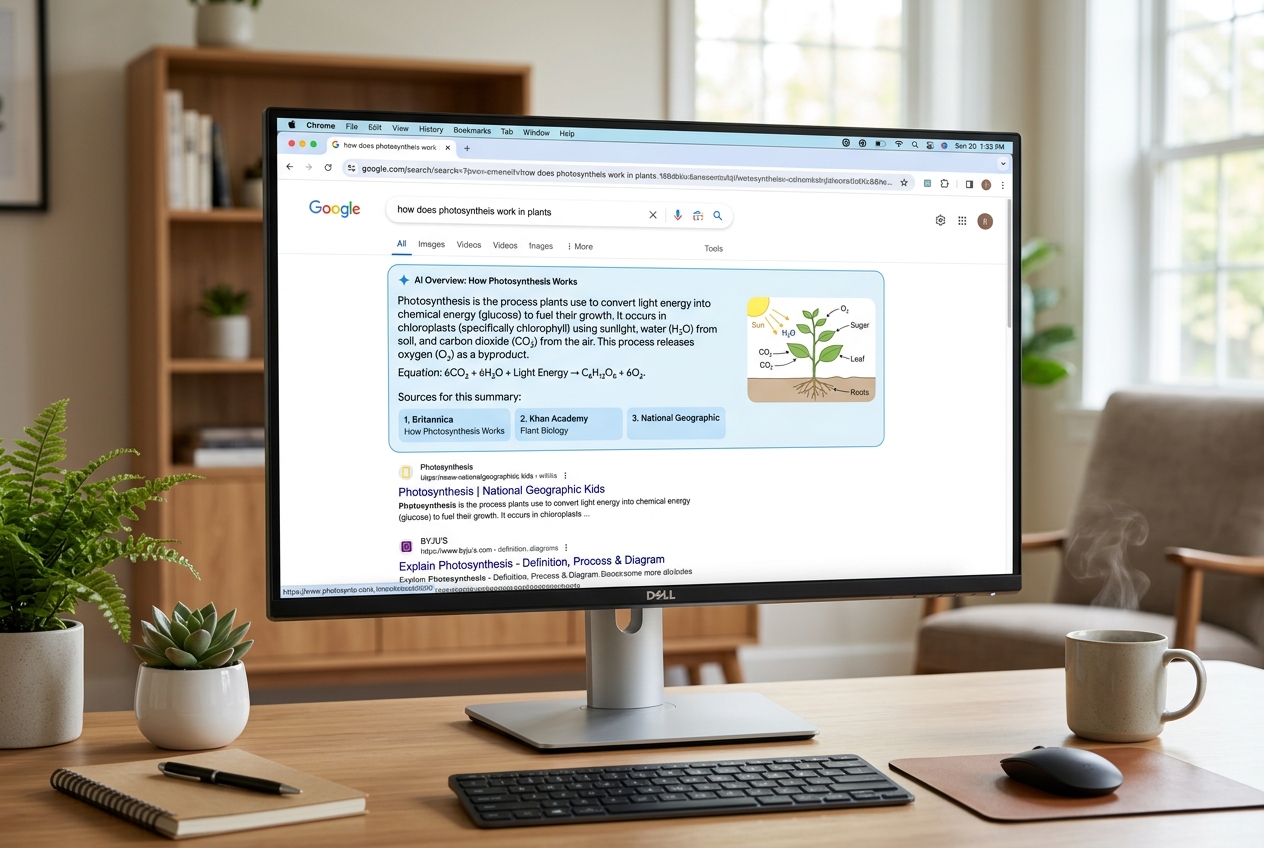
Google AI Overviews vs ChatGPT: a practical comparison
| Consideration | Google AI Overviews | ChatGPT |
|---|---|---|
| Where people see it | Within Google Search | Within a conversational assistant |
| Typical starting point | A search query | A prompt, often with conversation context |
| Source references | Can link to supporting web pages | May cite sources when search is used |
| Useful foundations | Accessible, relevant and helpful website content | Clear, credible and publicly discoverable brand information |
| Can a brand buy or guarantee inclusion? | No guaranteed organic inclusion | No guaranteed recommendation |
The table is a guide to the user experience, not a description of proprietary ranking formulas. Both products evolve, so brand checks should be repeated instead of relying on one screenshot.
Why might your business appear in one but not the other?
1. The questions may not actually be equivalent
Compare “SEO agency for a technical website audit” with “Which marketing company should I hire?” The first question specifies a service. The second asks for broad recommendations. Even if both are entered into the same product, the set of relevant answers may differ. To run a meaningful check, use the same business category, location context and level of detail in both questions.
2. A response is not a live, permanent ranking position
Traditional ranking tools encourage people to think in terms of positions. An AI answer is more fluid. It may summarise a topic without naming any provider, list several brands or cite an article rather than a homepage. A single mention is useful evidence, but it is not proof of consistent visibility across users or prompts.
3. Search access and source selection are not identical
Google’s documented guidance says that established SEO practices remain relevant to its AI Search features. For ChatGPT search, OpenAI explains that website owners can allow the OAI-SearchBot crawler so pages are eligible to be included in search results. Eligibility does not guarantee selection. Technical accessibility is therefore important, but it is only one part of the picture.
4. Your brand information may be incomplete or inconsistent
Imagine a company describing a specialist service on its website, while its business description and older articles still position it as a general provider. That inconsistency can also confuse customers. Clear service pages, straightforward explanations and consistent public contact information create a more dependable source of facts. Structured data can support that clarity when it accurately reflects the page, but adding schema alone will not force an AI mention.
5. The answer may not require a brand at all
Someone asking “What does an SEO audit include?” may receive a definition and checklist rather than business recommendations. Instead of judging every brand-free response as failure, match the content to the actual user intent. Some questions need useful educational information; others need a provider comparison or contact details.
How to check your brand visibility across both platforms
A practical review is better than repeatedly typing the brand name and hoping to see it. Use the following five-step process.
- Choose three search intentions. Test an informational query (“What is AEO?”), a service query (“technical SEO audit provider”) and a comparison query (“how to choose an SEO agency”). Adapt them to your business rather than stuffing keywords into every prompt.
- Record what appears. Note the date, exact query, whether search was used, which companies are named, and any cited URLs. Save screenshots for your own reference, but do not present them as universal results.
- Check factual accuracy. Look for outdated service descriptions, missing contact information and references to unrelated businesses. A wrong answer can be more important to fix than a missing mention.
- Inspect the website foundations. Review indexability, robots instructions, essential page content, internal links and the readability of your service descriptions. If you are troubleshooting ChatGPT search, check whether your setup permits relevant search crawler access.
- Improve the source material, then compare again. Strengthen pages that genuinely answer customer questions and track whether the situation changes. Use a consistent review method; avoid drawing conclusions from one response.
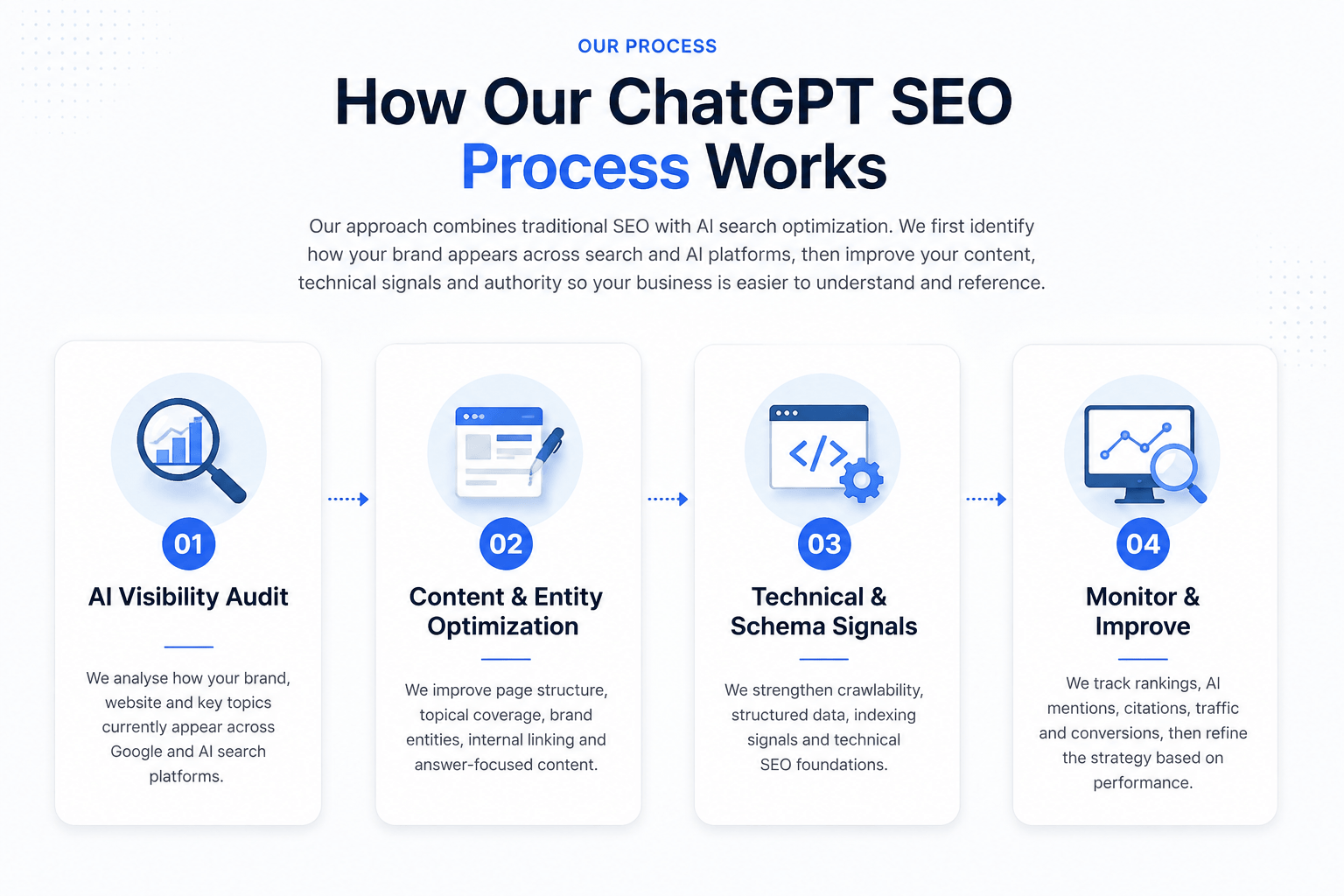
Which improvements should a business prioritise?
Start with the pages most likely to help a real customer make a decision. A service page should explain what the service is, who it is for, what work is involved and how to enquire. An article should tackle a clear question without repeating a service page’s sales message.
For example, a business that already has a page targeting “AI SEO agency” usually does not need five new articles that target the same phrase. It might benefit more from one focused comparison, an implementation checklist or an explanation of how to measure visibility. This keeps the main service page commercially focused and lets supporting articles address narrower questions.
Businesses can explore Answer Engine Optimisation (AEO) for clearer question-based content, Generative Engine Optimisation (GEO) for AI-search-oriented content and brand clarity, and ChatGPT SEO services for the practical considerations around conversational discovery. All of these should build on sound SEO foundations, rather than replace them.
How should you measure progress?
Measure what can actually be observed. Google Search Console remains useful for search performance, including clicks, impressions and affected landing pages. Website analytics can show visits and enquiries from identifiable referring sources where that information is available. For AI answers, keep a separate, clearly documented sample of queries, citations and brand mentions. Do not combine those into one invented “AI ranking position”.
More important, connect improvements to the business outcome. An accurate AI citation to a helpful page can be valuable, but it should sit alongside qualified enquiries, engaged visits and the quality of the information customers find when they arrive.
Frequently asked questions
Does ranking first on Google mean ChatGPT will recommend my business?
No. Google Search visibility and ChatGPT responses are not the same ranking system. A strong website may help customers and search systems understand your business, but it cannot guarantee a mention.
Do I need separate websites for SEO, AEO and GEO?
Usually not. One clear, accessible website with distinct, useful service pages and supporting articles is generally a more sensible foundation than multiplying websites with overlapping content.
Will adding JSON-LD guarantee inclusion in AI answers?
No. Accurate structured data can clarify entities and page information for systems that use it, but it is not a guaranteed route into Google AI Overviews or ChatGPT answers.
A more practical next step
If your brand appears in Google but rarely surfaces in conversational answers, begin with a content and technical review rather than publishing dozens of similar articles. Contact PixelPro to discuss a focused SEO and AI search visibility review based on your website, target customers and business goals.
Want to improve your visibility across Google and AI search?
Speak with PixelPro about a practical SEO and AI search review.
Sources and further reading
- Google Search Central — AI features and your website
- Google Search Central — Guide to optimising for generative AI features
- OpenAI Help Center — Searching the web with ChatGPT
