
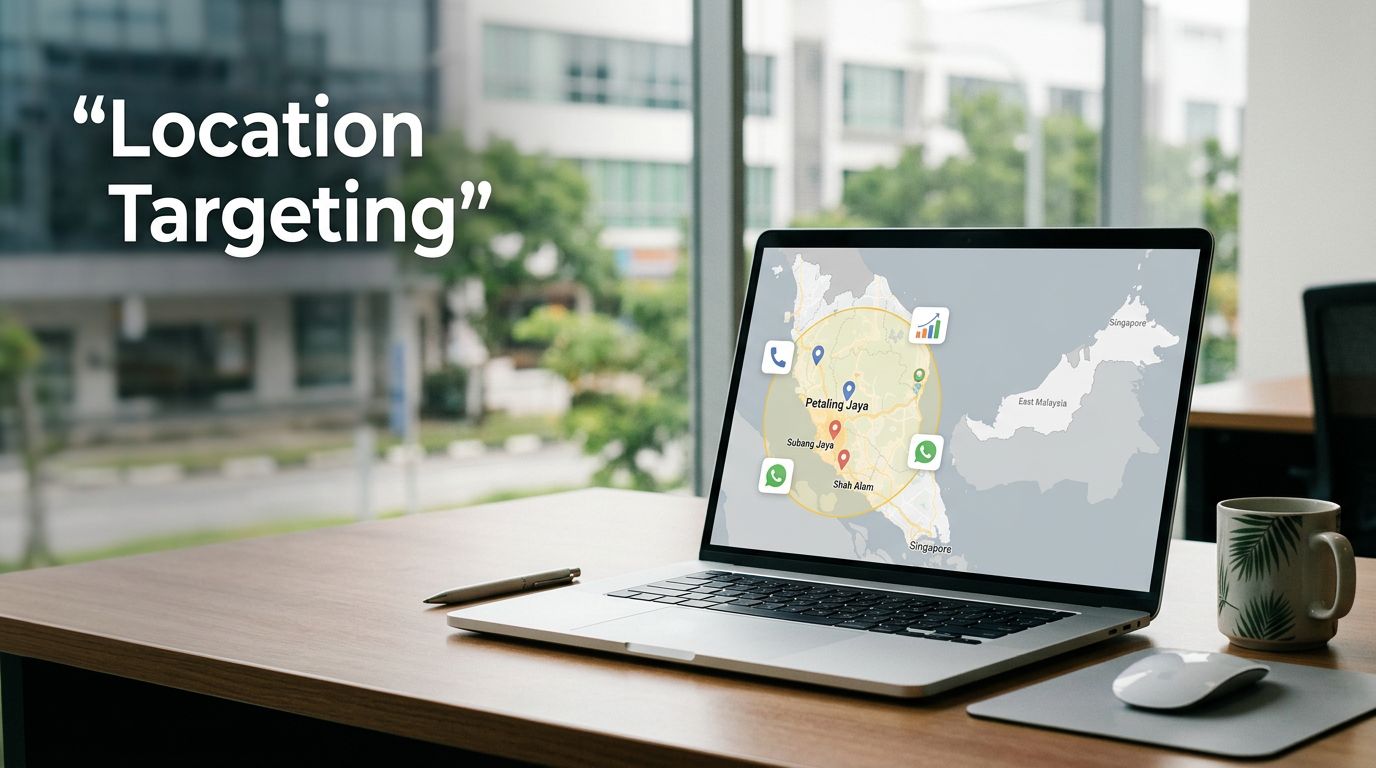
A service business can pay for a click from Penang even when its team only works in Petaling Jaya. Google Ads location targeting helps avoid wasting ad spend on clicks outside the area you can serve.
For local businesses in Malaysia, the goal isn’t more clicks. Use real service boundaries to define a realistic target audience and attract more relevant calls, WhatsApp enquiries, bookings, site visits, and sales. Let performance data guide expansion.
Direct answer: Google Ads location targeting protects local ad budgets
Google Ads location targeting lets you show campaigns in selected countries, states, cities, areas, or radius zones. A plumber in Shah Alam, for example, can focus on reachable neighbourhoods instead of paying for searches across Malaysia.
The right setup matches your business model. Local providers should keep search campaigns narrow, while remote B2B firms can cover Malaysia more broadly. Broader settings may include locations of interest, so use them only when those searchers can become valid customers.
Google supports geographic locations including countries, states, cities, districts, and radius zones through its advanced location options.
Key takeaways
- Target the locations where your staff, delivery, or service process can reliably support customers.
- Use Presence targeting with location exclusions when customers must be physically located in your service area.
- Align your bidding strategy with qualified lead value, then measure calls and qualified enquiries by location before increasing geographic coverage.
Build campaigns around actual Malaysian service coverage
Before creating a campaign, map the geographic areas you can support profitably today. Use them to guide location targeting. Include travel limits, branch locations, operating hours, delivery zones, and the value of a completed job.

Match geography to the way customers buy
A Kuala Lumpur air-conditioning contractor may need city and radius targeting. An online accounting firm may accept enquiries from across Malaysia, with other locations of interest if its service is genuinely remote. A tuition centre with branches in Setapak and Cheras should usually separate each area, so budget and lead quality for target customers remain visible.
| Business type | Practical geographic setup | Reason |
|---|---|---|
| Emergency contractor | Radius or nearby city targeting | Travel time affects response and profitability |
| Multi-branch clinic | Separate campaigns by branch area | Each branch needs its own budget and reporting |
| Malaysia-wide B2B service | Malaysia targeting with qualified lead tracking | The service can be delivered remotely |
| Local education centre | Target surrounding neighbourhoods | Parents usually prefer nearby classes |
Businesses that need structured support can pair this planning with PPC advertising services in Malaysia to connect geographic settings, keyword intent, landing pages, and conversion tracking.
Keep countries in separate campaigns
Don’t place Malaysia, Singapore, Indonesia, and other geographical regions in one campaign merely because the service is available online. Search behaviour, competition, currencies, sales value, and customer expectations differ.
Each market should have its own search campaigns, budget, language assumptions, and reporting. This keeps budgets clean and stops lower-value markets from consuming spend intended for Malaysian enquiries. A Google Ads location targeting plan should reflect commercial value, not only language overlap.
Choose Presence before launching local campaigns
Google’s broad default setting is “Presence or Interest.” It can reach people physically in or regularly in a target area, plus people showing interest in locations of interest within it. This can suit a business that wants enquiries from people researching a future move or an upcoming visit.
Use Presence for services tied to a physical area
Choose “Presence” when your target audience must be physically nearby. This is often the better option for renovation contractors, dental clinics, restaurants, pest-control companies, and repair services.
For example, a Subang Jaya locksmith, clinic, or contractor usually doesn’t need clicks from someone overseas researching the area or its locations of interest. However, a Kuala Lumpur immigration firm that assists overseas applicants may intentionally use the broader setting.
Add locations with a repeatable process
Google’s interface changes occasionally, but campaign-level location controls remain the starting point. Use a simple workflow:
- Open the campaign settings and choose the locations section.
- Search for a country, state, city, district, or radius around a location.
- Select the appropriate location options, then save the campaign.
- Prepare larger service-area lists for bulk location targeting before pasting them into Google Ads.
Users of the Google Ads API can use GeoTargetConstantService to resolve a location, retain its criterion ID, and map it to the relevant campaign criterion. Validate the criterion ID and corresponding campaign criterion before launch or upload.
Google Ads supports bulk lists of up to 1,000 location targets at a time. Check spelling and coverage before uploading or pasting a large list. Google’s geographic targeting guidance also explains how location selections work across campaign types.
Use radius targeting and exclusions with care
Radius targeting draws a circle around a chosen point. This proximity targeting approach works well when a business has a defined travel zone, such as a home cleaner based in Bangsar or a mobile tyre service near Puchong.
Set a realistic radius for your team
Google Ads does not allow a radius smaller than 1 km. Use Google’s radius-targeting setup instructions when configuring the area.
A service radius should account for traffic, tolls, job duration, and technician availability. A small radius can also limit reach so heavily that ads show only intermittently. If impressions are low, review search demand and available coverage before raising bids.
Exclude areas that create unsuitable leads
Location exclusions prevent ads from appearing in unsuitable areas. Treat negative locations as places unlikely to produce profitable or serviceable enquiries.
A Selangor-based contractor might exclude distant states. A premium service provider may remove areas outside its delivery capacity.
Google lets advertisers exclude individual locations or bulk lists through the same general process used for targeting. Record each criterion ID and exclusion status consistently for every campaign criterion. Its location exclusion guidance covers the available controls.
Choose exclusion settings carefully. A broad exclusion can also block people researching locations of interest in an excluded area. Presence-based exclusions are more suitable when you only want to remove people likely to be physically located in that area.
Measure qualified leads, not only low-cost clicks
Geographic settings need regular review as ad performance changes. A city may generate low-cost clicks but poor enquiries. Another area may cost more per lead yet produce booked jobs and a stronger return on investment.

In reports, separate locations of interest signals from confirmed physical presence. This prevents interest in an area from being mistaken for a local customer.
Track the actions that matter to sales
Track conversion rates for meaningful outcomes. These include completed enquiry forms, phone calls of suitable duration, WhatsApp conversations, appointment bookings, and confirmed sales. Conversion volume alone doesn’t prove lead quality. A form submission without a reachable customer shouldn’t receive the same value as a signed project.
Where possible, ask the sales team to label leads by quality and source. This reveals whether a particular district produces serious buyers, price shoppers, spam, or enquiries outside your actual service scope. It also helps assess ad relevance by checking whether location-specific ads and landing pages match the user’s service need.
A location setting controls ad eligibility, but only lead outcomes show whether that area deserves more budget.
Adjust one geographic decision at a time
Review cost per qualified lead, booking rate, and revenue potential by location. Then adjust one factor, such as an excluded area, a city bid, or a radius size. Changing a geographic setting and bidding strategy at once makes it difficult to identify what improved lead quality.
For larger advertisers, the Google Ads API can join each location’s criterion ID to CRM outcomes. Before changing budgets, validate the criterion ID, confirm the campaign criterion matches the location, and verify the campaign criterion is active.
In search campaigns using AI Max, “locations of interest” can be applied at ad-group level to reach users searching for or interested in selected areas. Google’s location targeting overview explains that this feature is optional, so it shouldn’t replace a clear campaign-level service area.
Connect paid search data with SEO and AI search visibility
Google Ads and organic search solve different problems, yet their data can support each other. Search campaigns reveal the terms, enquiry outcomes, and geographic signals behind prospective customers’ needs. Paid reports may also show patterns in locations of interest. These insights can improve service pages, FAQs, local landing pages, and Google Business Profile content.
An AI SEO agency can use location targeting reports and recurring customer questions to create well-structured content for Google Search, AI-generated answers, and answer engines. AI SEO depends on clear entities, helpful headings, accurate service details, internal links, and topical coverage. It does not depend on stuffing locations into every paragraph.
For local SEO Malaysia work, build pages around genuine locations, branch details, service constraints, and real customer needs. Strong SEO services in Malaysia can support long-term visibility while paid campaigns test immediate demand.
A Malaysia-based AI SEO agency should also prepare content for AI Overviews, AEO, GEO, and LLM search platforms. Semantic content structure helps systems understand who you are, what you offer, and where you operate. For businesses evaluating generative visibility, GEO services in Malaysia can strengthen those foundations.
A trusted AI SEO agency will explain what it measures, which pages need work, and how paid and organic channels contribute to qualified enquiries. Reports may reveal locations of interest, but they don’t confirm genuine service coverage. Google Ads location targeting cannot place a business in an AI answer by itself. It can reveal local intent worth serving through better content.
Location settings should follow service reality
The strongest geographic setup reflects the work your business can complete profitably. Not every interest signal tied to locations of interest should define a service area unless it produces a valid, profitable enquiry. Start with defined service areas, use Presence when local proximity matters, and remove locations that produce unsuitable leads.
Paid campaign data becomes more useful when it feeds landing-page improvements, local SEO, and lead qualification. If you want to align location targeting with a practical growth plan, speak with an SEO consultant about your website, campaign structure, and enquiry tracking.
Frequently asked questions
Should a Malaysian service business use Presence targeting?
Use Presence when customers need to be physically located in your selected area. This usually fits local contractors, clinics, restaurants, home services, and education centres. Local campaigns may also reach people based on locations of interest, creating unsuitable leads when they aren’t nearby. Use Presence or Interest only when people outside the area can still become valid customers.
Can I target a radius smaller than 1 km?
No. Google Ads requires a minimum radius of 1 km. If that area produces too little traffic, expand gradually or target relevant nearby districts and cities instead.
Can I add and exclude many cities at once?
Yes. Google Ads supports bulk location lists for up to 1,000 targets or exclusions at a time. A criterion ID identifies the selected location, while a campaign criterion attaches it to a specific campaign. Larger accounts can also manage geographic criteria programmatically through the Google Ads API, using campaign criteria and location identifiers.
Before changing a target or exclusion, validate the criterion ID against the intended location. Also confirm that the campaign criterion belongs to the intended campaign.
Does location targeting improve AI search visibility?
Location targeting affects paid ad delivery, not organic rankings or AI-generated search answers. However, local queries, calls, and conversion data from campaigns can reveal patterns in locations of interest. Use these insights to guide better service pages, local FAQs, and entity-focused content.
