
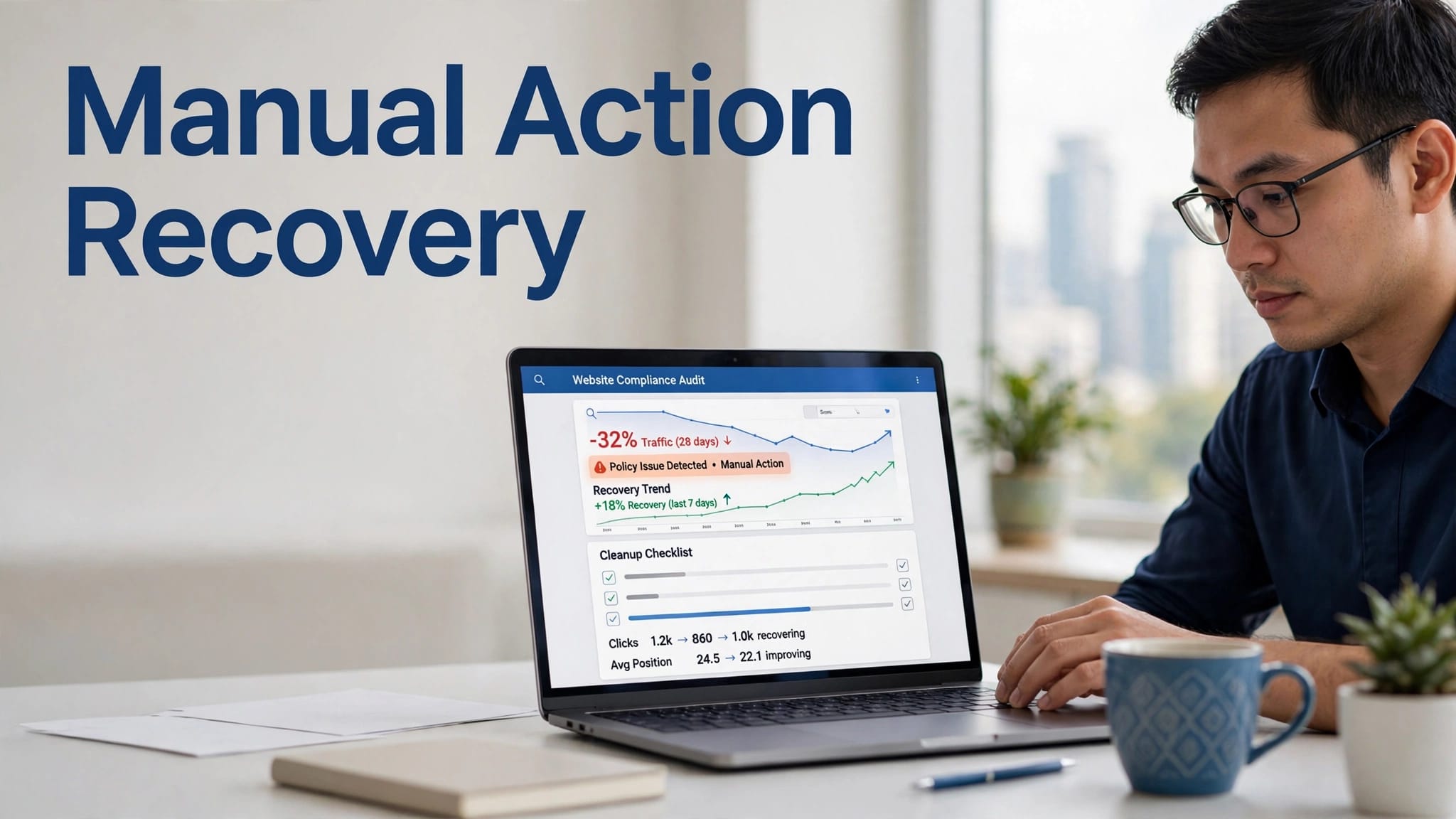
A sudden collapse in organic traffic can feel like a switch has been turned off, but a general decline isn’t automatically a manual action. When one is confirmed, Google manual action recovery requires a documented cleanup of the actual policy breach, followed by a clear reconsideration request.
For a Malaysian SME, that drop can mean fewer form enquiries, WhatsApp leads, bookings, and sales. A rushed fix often wastes weeks, while a methodical one gives Google a complete record of what changed.
Start by confirming the action, its scope, and the exact issue named in Google Search Console.
The direct answer on Google manual action recovery
Google manual action recovery means identifying the violation reported in Search Console and correcting it across every affected area. It also requires submitting a reconsideration request through the review process. A human reviewer assesses the evidence and either revokes the action or explains that more work is needed.
In Google Search Console, open Security & Manual Actions > Manual actions. Google’s Manual Actions report guidance explains the process, including the need to fix all affected pages before selecting “Request Review.” Older references may mention the webmaster guidelines. Follow Google’s current spam policies and use this review process, not a separate webspam team.
A manual action is removed only after the underlying issue has been fixed. Editing one page or deleting a handful of links rarely solves a sitewide problem.
Key takeaways
- Check the manual actions report before assuming an algorithm update caused the loss.
- Fix the policy violation throughout the website, including old blogs, user profiles, subdomains, and forgotten landing pages.
- Keep evidence of removed links, rewritten content, technical changes, and outreach attempts.
- Submit one factual reconsideration request after the cleanup is complete.
- Continue monitoring traffic, index coverage, enquiries, and branded searches after the action is revoked.
Manual action or algorithmic demotion?
A manual action is a penalty applied after a Google reviewer finds a breach of Google’s spam policies. The manual actions report shows the issue and whether it affects particular URLs or the whole site.
An algorithmic demotion is different. It isn’t shown in that report. Automated algorithms can change search rankings after a core update, technical problems, competition, weak content, or changed search intent.
Use evidence before choosing a recovery plan
Check the date when impressions and clicks dropped in Google Search Console. Then compare it with website changes, redirects, migrations, plugin updates, removed pages, and marketing campaigns.
Older references to Google’s webmaster guidelines don’t replace checking the current report. If it’s clean, don’t submit a reconsideration request. Instead, investigate site quality and technical health. This guide to Google core update recovery can help investigate a separate algorithmic decline.
Triage the problem before changing the website
Open the notification in Google Search Console and export its details. Record the date, affected property, action type, and affected scope. Then use the URL inspection tool to verify representative affected URLs. Give this file to everyone involved, including your web developer, content team, marketing staff, and agency.
Next, protect the evidence. Don’t delete analytics access, backlink profile exports, outreach emails, or historic content without recording what was there. A contractor in Selangor, a Kuala Lumpur clinic, or an eCommerce store may have years of agency work and old campaigns behind one action.
Build a recovery log
A useful log names the property, action type, affected scope, date, owner, and affected URL. Record the suspected issue, corrective action, completion date, and supporting proof. For example, link removals can include contact attempts and reply screenshots. Content improvements can include before-and-after URLs and publication dates.
Prioritise serious indexing issues, dangerous redirects, compromised pages, and obvious paid-link activity first. Check whether unwanted URLs remain in the search index. A practical SEO audit checklist for Malaysia helps teams organise technical findings without losing sight of the manual action. It supports the manual-action recovery plan, but doesn’t replace fixing the specific violation named in the report.
Remove unnatural links with care
An unnatural links action may involve links pointing to your site or links leaving it. Inbound issues often involve past paid placements, private blog networks, automated directory campaigns, or manipulative anchor text. Outbound issues may come from selling links, advertorials without proper attributes, or sitewide links placed to influence search rankings.
Review the backlink profile with Search Console data and reputable link analysis tools. Look for patterns, not isolated low-quality domains. A random scraper link isn’t automatically evidence of a violation. However, hundreds of keyword-rich links to a Malaysian service page may point to coordinated link schemes and deserve close review.
Contact publishers before using disavow
Ask website owners to remove links you control or clearly arranged. Keep the message short and polite:
Subject: Request to remove a link
Hello, we are reviewing older marketing activity and found a link to our website on your page. Please remove the link when possible. We have included the source page and destination page for reference. Thank you.
Record the date, email address, contact attempt, source URL, and response. Check important destination pages and redirect outcomes with the URL inspection tool. Don’t threaten publishers or offer payments for removal.
If removal remains impossible after reasonable attempts, follow Google’s Disavow Links tool guidance. Disavow isn’t a substitute for reasonable removal efforts, so submit only URLs or domains connected to the identified issue. A careless disavow file can exclude links that genuinely help your website.
Clean outbound links too
Review sponsored posts, partner pages, footer links, advertorial archives, and affiliate content. For paid or promotional links, add rel="sponsored" or use rel=nofollow, written in HTML as rel="nofollow". Remove links that were placed purely to manipulate rankings.
For WordPress websites, inspect widgets, theme footer settings, author bio boxes, and expired campaign pages. These areas often carry old links that nobody has reviewed for years.
Replace thin content with useful pages
Thin content isn’t simply short content. A 250-word page can help if it directly answers a customer’s question and provides real information. A 2,000-word page can still be unhelpful if it repeats generic advice, copies supplier descriptions, or targets similar keywords without serving users.
Older references may call these the webmaster guidelines. Google’s spam policies for web search cover practices that can lead to pages being demoted or removed. Search quality guidelines offer subjective quality advice, but they aren’t a substitute for checking the applicable policy.
Review service pages, location pages, product filters, blog archives, and automatically generated pages against those policies. Also check user profiles, comments, forums, and other automatically populated areas for user-generated spam.
Give every important page a job
Each important page needs a genuine business purpose, original information, accurate local details, a clear enquiry path, and useful internal links. A Kuala Lumpur tuition centre’s course page should explain the age group, syllabus, class format, location, tutor credentials, fees or enquiry path, and relevant parent questions. A plumbing business should show genuine service coverage, emergency contact details, the expected process, and useful guidance.
Delete or consolidate near-duplicate pages, including doorway pages built around location or service variations. Rewrite pages that merely swap town names, service names, or keywords, but don’t delete a useful page solely because it’s short. Where a page has a valid business purpose, add original explanations, real images where appropriate, clear contact routes, and internal links to related services.
Stop keyword stuffing and hidden text
Repeating “best contractor in Malaysia” in every paragraph doesn’t strengthen relevance or improve search rankings. This kind of keyword stuffing makes the page harder to read and can trigger a spam issue when combined with hidden copy, tiny text, CSS-hidden keywords, or misleading tabs.
Use the phrases customers would naturally use, then answer their intent with complete information. Clear headings, descriptive internal links, and factual service details are stronger than repeated keyword variations.
Check cloaking and sneaky redirects, and structured data
Cloaking shows Google different content from users in a deceptive way. Sneaky redirects send users to destinations they didn’t expect, unlike ordinary redirects. Both can appear after hacked plugins, malicious scripts, mobile-only redirects, or poorly managed tracking tools.
Test important pages as a regular visitor and through the URL inspection tool. Check desktop and mobile templates, language versions, campaign URLs, and redirects from old domains.
Structured data must match the visible page
Structured data can improve eligibility for rich results, but it must reflect information visible to users. Google’s structured data policies state that a structured data manual action affects rich-result eligibility, not standard search rankings.
Remove or correct markup that claims reviews, prices, availability, events, or business details that visitors cannot see or verify. Then validate the corrected markup before asking for review.
Write a reconsideration request that proves the work
A reconsideration request isn’t a sales pitch. It should help a human reviewer verify that you understood the problem, completed the cleanup, and changed the practices that caused it.
State the action type in the opening line. Then explain what your audit found, the exact corrective work, and the evidence available. If an external agency built paid links or generated pages, say so plainly, then explain what the business changed. Write for the review process, not for an imagined webspam team, and don’t promise restored search rankings.
Include practical evidence
For an unnatural links action, explain how you audited the backlink profile and how many removal requests you sent. Record which links were removed, then confirm that you submitted a focused file in the disavow links tool for links you couldn’t remove.
For thin content, identify which URL groups you merged, deleted, or rebuilt. For cloaking, redirects, or doorway pages, name the script, redirect rule, or plugin that caused the issue. Confirm the cause was removed across the site and provide representative corrected URLs from the URL inspection tool.
Keep the request concise but complete. Google needs facts, not vague claims about search quality guidelines or promises to follow webmaster guidelines.
How long reconsideration review takes
Google does not publish a fixed turnaround time for a reconsideration request. Check the manual actions report for its status and response. Search Console sends an email when the review begins and another when Google reaches a decision.
Submit a reconsideration request only after cleanup is complete; it isn’t the response to an algorithmic demotion. Avoid submitting a duplicate while one is pending, because it doesn’t speed up the process and can confuse the recovery record.
If Google rejects the request, read its response against your log. “Penalty removal” is informal shorthand; Google actually reviews whether the manual action should be revoked. Use the URL inspection tool to check representative templates, folders, subdomains, and legacy URLs in the search index. Many rejected requests fail because the team fixed visible examples but missed the same problem elsewhere.
Protect recovery work as AI search expands
AI-generated search answers don’t create a shortcut around Google’s quality requirements. Google says its standard guidance still applies to AI features. This includes crawlable content, clear internal links, helpful text, good page experience, and visible content that matches structured data. Review Google’s guidance for AI features in Search before changing pages for AI Overviews.
An AI SEO Agency may help review content, but AI-assisted publishing remains subject to Google’s spam policies. Avoid generic pages, and have a human verify Malaysian service areas, pricing, claims, business details, and customer questions.
Build pages that answer real customer questions
During recovery, improve pages for users rather than trying to influence AI-generated answers. Each page should answer a genuine customer question and accurately describe the service.
Automated algorithms and AI search features don’t replace the human review needed for a reconsideration request. Any Answer engine optimization services used during recovery should support fact-checking and content review, not mass page creation.
What to expect from recovery support
A qualified technical SEO support partner should begin with access, evidence, and a written plan. They should request Google Search Console, analytics, CMS, previous agency records, and backlink history. Professional support is especially useful when recovery involves templates, redirects, legacy campaigns, or a complex backlink profile.
A credible partner can help document the work, prepare evidence, and submit a reconsideration request. No partner can promise a successful review or restored search rankings. Trust comes from transparent reporting, documented changes, realistic expectations, and advice that protects your business instead of chasing shortcuts.
Recovery work should support commercial goals
Once the manual action issue is addressed, the next task is turning recovered organic traffic into enquiries and sales. Improve service pages, calls to action, local landing pages, page speed, mobile usability, internal links, and conversion tracking.
A restaurant may need booking paths and accurate menu details. A professional firm may need service comparisons, credentials, and consultation forms. An eCommerce store may need product information that answers delivery, returns, sizing, and warranty questions.
To discuss an audit, explore PixelPro’s SEO services in Malaysia, which cover technical review, content structure, local signals, and performance tracking for businesses seeking durable organic growth.
A recovery plan is stronger than a quick fix
A Google manual action is serious, but it is also specific. Read the report, repair every instance of the violation, document the work, and submit a reconsideration request only when cleanup is complete. If the report is clean, investigate an algorithmic demotion instead; informal penalty removal claims don’t replace a documented recovery process.
Long-term visibility comes from useful, verifiable content and sound technical practices. These standards support sustainable search rankings and qualified organic traffic. They also make your site more dependable for Google Search, AI-generated answers, and Malaysian customers deciding whether to contact you.
If you want a second opinion on a penalty notice or traffic decline, get an SEO audit from PixelPro and discuss a practical path to stronger Google visibility and qualified enquiries.
Frequently asked questions
Can I recover from a manual action without a reconsideration request?
No. Fix the reported issue first, then submit a reconsideration request through the manual actions report. Google must review the changes before removing the action.
Does deleting a few bad backlinks remove an unnatural links action?
Usually, no. Google expects a good-faith cleanup of the underlying link scheme. Remove unnatural links where possible, document the outreach, and disavow only problematic links you can’t remove.
Can AI-written content cause a manual action?
AI assistance alone doesn’t make a page pure spam. Problems arise when a site publishes deceptive, copied, keyword-stuffed, or low-value pages at scale. Each page still needs accurate information, a clear purpose, and genuine value for visitors.
Will revoked manual action rankings return immediately?
A revoked action allows Google to reassess the site, but rankings may not return to their former positions straight away. Recovery depends on crawl timing, indexing, content quality, competition, technical health, and the links that remain after cleanup.
