
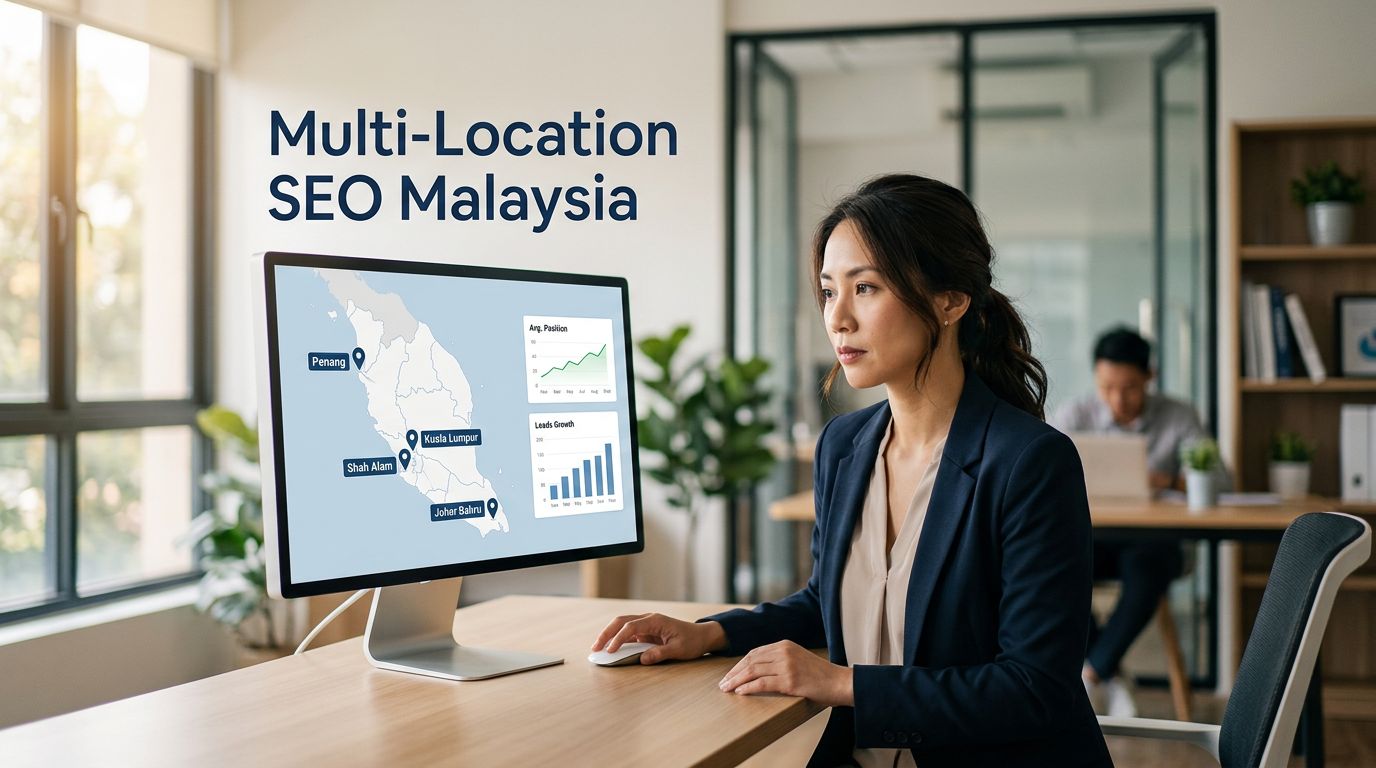
A company can operate several branches yet remain hard to find in some locations. Multi-location SEO helps each genuine outlet show customers the right address, opening hours, services and contact details. For Malaysian businesses with offices or branches in different cities, the work starts with accurate Google Business Profiles, useful location pages and tracking enquiries by branch—not publishing duplicate pages with city names swapped.
Customers in Bangsar, Shah Alam, Penang and Johor Bahru usually want accurate information about the nearest branch, not a general corporate description. If you are comparing local SEO companies, ask how they maintain separate branch details, prevent duplicate listings and measure calls or bookings for each location. These tasks connect with wider SEO services and practical local citation checks.
How Should a Business Manage SEO Across Multiple Branches?
Multi-location businesses should treat every branch as its own local entity. Each outlet needs a verified Google Business Profile, accurate business details, a unique location page, local proof, and branch-level tracking. Its profile, page, and offer should match its own local search intent.
Google evaluates local results through three core local ranking factors: relevance, distance, and prominence. Relevance is how closely a branch matches the query. Distance is how close it is to the searcher or named area. Prominence reflects the branch’s online and offline reputation.
Key takeaways for a practical local programme:
- Give every genuine location one reliable set of business details across your website, maps, and directories.
- Build local relevance with original branch information instead of copying one page across every city.
- Track calls, WhatsApp leads, bookings, direction requests, and sales by branch, not only keyword positions.
A multi-location local SEO Malaysia plan starts with branch accountability
A single-location business can often manage one profile and one contact page. Branch networks need an operating system. Without it, a changed phone number in Petaling Jaya or an outdated holiday hour in Melaka can spread across maps, directories, social profiles, and customer messages.
Create one internal location record for each branch to support NAP consistency. This approved source of truth should contain the business name, street address, unit number, primary phone number, operating hours, category, services, location URL, opening date, map pin, and local contact owner. Marketing teams should publish from this record instead of relying on old spreadsheets or staff memory.

Central control doesn’t mean every location looks identical. A Selangor contractor may offer a different service mix than its Johor branch. A clinic in Kuala Lumpur may have different doctors, facilities, parking arrangements, and consultation hours. Those distinctions belong in the branch record and public content.
Assign ownership clearly. Head office should manage standards, access, templates, and reporting. Branch managers should confirm operational changes, supply current photos, and flag customer issues. This prevents local search visibility from becoming a one-off cleanup project.
Google Business Profiles shape Google Maps rankings
Give every customer-facing, eligible branch its own verified Google Business Profile. Do not combine multiple physical outlets into one listing, and do not create profiles for locations that don’t meet Google’s business eligibility rules.
Choose the most accurate primary category for each outlet. A dental clinic, tuition centre, restaurant, law firm, and renovation contractor may share a parent brand, yet they need categories that reflect what customers can receive at that location. Add relevant secondary categories and services only when the branch genuinely provides them.
Complete the profile with correct hours, appointment links, attributes, services, photographs, and a branch-specific website URL. Ongoing Google Business Profile optimisation keeps these details accurate as the branch changes. Useful Google Business Profile fundamentals also reinforce why profile completeness and regular maintenance matter for local discovery.

Never insert extra keywords or suburb names into the official business name just to rank. Google expects the name to match real-world branding. Also avoid using one call-tracking number as the primary phone number everywhere if it conflicts with the number shown on the website and major listings.
Local Pack rankings can vary across a city because proximity matters. A report based only on a search made from your head office gives an incomplete picture. Use postcode-level or grid-based checks, then compare them with calls, direction requests, form submissions, and bookings.
Build location landing pages that prove local relevance
Your location landing pages should answer the practical questions a local customer asks before contacting you. Each branch page needs a clear title, accurate NAP details, available services, opening hours, contact options, and map or directions. Mobile optimisation should make calling, WhatsApp contact, booking, and directions easy.
For example, a useful page may explain wheelchair access, parking, nearby transport, service coverage, available specialists, delivery areas, or branch-specific booking rules. First-party photos, genuine testimonials, and customer reviews add proof when they reflect real experiences. Relevant FAQs can provide further clarity.
Use local keyword targeting to reflect real services, nearby areas, and customer needs, rather than merely swapping suburb names. Search engines can recognise thin, repetitive pages, while customers can spot generic copy immediately. A meaningful location page gives each branch a reason to exist in search results.

Use a location taxonomy that can grow
A clear structure keeps location landing pages organised as the network expands. A national brand might use a locator page, state hubs, city hubs, then individual branch URLs such as /locations/selangor/shah-alam/. Link city hubs to individual branch pages, and link each branch back to the wider area.
This structure helps users move between nearby options. It also tells search engines how branches relate to the parent company. The page planning principles in this multi-location SEO checklist support a disciplined approach to profiles, content, and local authority.
Add LocalBusiness schema markup to every genuine branch page. Depending on the business, a more precise type such as Restaurant, MedicalClinic, LegalService, or EducationalOrganization may fit better. Include the branch name, address, telephone, opening hours, geo coordinates, URL, parent organisation, and relevant areaServed details.
Schema validates facts that users can see on the page. It does not turn a non-existent location into a local result. Keep every marked-up detail accurate, and update it when operations change.
NAP, reviews, and local authority need firm governance
NAP consistency means the name, address, and phone number match across your website, Google Business Profile, Apple Maps, Waze, Bing Places, Facebook, industry directories, and local listings. Small differences can cause trouble when they create doubt about which listing belongs to the business.
Common problems include old suite numbers, an abandoned branch phone number, different spelling for the business name, or one location using the head-office address. Audit listings after relocations, mergers, rebrands, and new branch launches. Use citation building to correct priority directories in a controlled process. Fix the website and Google profile first, then update important third-party platforms.
Local SEO reviews also affect prominence and customer confidence. Ask customers for an honest review after a completed service, purchase, class, or appointment. Give staff a simple process, but do not offer incentives or filter out unhappy customers before asking.
Treat review management as a documented process for responding to complaints and learning from recurring feedback. Thank satisfied customers without copying the same reply. Address genuine complaints professionally, then move personal matters offline. A steady flow of recent, credible reviews is more useful than a short burst of suspicious activity.
Malaysia’s multilingual local search habits add another layer. Customers may search in English, Bahasa Malaysia, Mandarin, or a mix of languages. Use language based on real enquiries and keyword research. Write useful local content for those audiences, rather than publishing low-quality machine translations or cramming several language variants into a business name.
Service area businesses can still compete locally
Operators without a public storefront can appear in the Google Local Pack. Contractors, mobile repair teams, cleaning companies, and home service providers should define a realistic service area. They should hide a residential address when customers don’t visit it.
Distance still affects visibility, so broad coverage claims won’t overcome a competitor closer to the searcher. Build area pages around places you genuinely serve. Support them with completed projects, local case studies, service availability, and realistic travel details.
Don’t use virtual offices, mailbox addresses, or duplicate profiles to create artificial coverage. Those shortcuts risk profile suspension and damage customer trust.
Put AI search visibility beside core local SEO
Traditional SEO remains the foundation of local visibility. However, customers also ask Google AI Overviews, ChatGPT, Gemini, and Perplexity where to find a nearby provider or which business suits a particular need.
AI SEO helps businesses present clear, connected information that answer engines can interpret. For multi-location brands, this means consistent entity details for the parent company and each branch, well-structured service pages, genuine reviews, concise FAQs, and original evidence of local expertise.
Answer engine optimisation, or AEO, focuses on direct responses to customer questions. Meanwhile, generative engine optimisation, or GEO, focuses on making brand facts, services, and expertise easier for generative systems to understand and reference. Neither practice guarantees inclusion in an AI-generated answer.
An AI SEO Agency should act as a local SEO agency for multi-location brands. It should connect AI search readiness with technical SEO, local content, structured data, and measurable branch-level lead generation.
A trusted provider won’t promise citations in ChatGPT or instant placement in AI Overviews. It will build the trustworthy source material that search engines, answer engines, and customers need.
Measure branches by leads, then set a realistic budget
Track performance separately for every branch. Rankings are useful diagnostics, but core measures should include qualified calls, WhatsApp conversations, direction requests, and booking completions. Use conversion rate optimisation to connect page improvements with calls, WhatsApp conversations, bookings, forms, and revenue where tracking allows.
Review search terms and landing-page visits in Google Search Console. Then connect website actions in GA4 to phone, booking, and WhatsApp events. Together, they show whether organic search traffic attracts the right customers, not merely more impressions.
For a short reminder that category accuracy, reviews, and profile quality affect map visibility, see these Google Maps ranking tactics.
Use these indicative monthly retainers as a starting benchmark when comparing an SEO Malaysia price:
| Programme scope | Typical monthly range | Common work included |
|---|---|---|
| One to three locations | RM1,500 to RM3,000 | Profile work, core citations, location landing pages, review process, reporting |
| Four to ten locations | RM3,000 to RM5,500 | Ongoing page improvements, location audits, content, authority work, branch reporting |
| Complex networks or franchises | RM5,500 to RM7,000+ | Governance, technical work, large-scale content, data management, advanced reporting |
A realistic SEO Malaysia price depends on competition, current data quality, website condition, branch count, language needs, and whether new location pages require development. Local competitor analysis can also shape the recommended scope. Good reporting should show completed work, changes in visibility, lead actions, and the next priorities.
Early profile improvements can appear within four to eight weeks. Competitive Local Pack gains usually need three to six months of consistent work. New branches may take longer because they have little review history, authority, or local awareness.
Choose a partner that protects the brand and the branch
A capable local SEO agency starts with an inventory of every outlet, its services, current listings, website pages, and conversion paths. Compare local SEO services Malaysia providers by scope, access ownership, approval processes, and location-level reporting.
Choose a local SEO agency with transparent review management, technical capability, multilingual content quality, and clear reporting. Request a technical SEO audit covering website health and branch-page issues, and confirm that customer reviews are genuine. Avoid providers promoting fake locations, paid reviews, fabricated or incentivised review activity, keyword-stuffed business names, or guaranteed Google Maps rankings.
A broader SEO Malaysia strategy should support the local programme through technical health, internal linking, and useful content. It should also include a local backlink strategy and location landing pages. Local visibility grows stronger when the website and branch data tell the same story.
Conclusion
Multi-location growth comes from treating each branch as a real local business, while managing the network with one reliable standard. Accurate profiles, original location pages, consistent data, and meaningful reviews turn local search visibility into calls, bookings, enquiries, and sales.
If your branch network needs clearer priorities, PixelPro can help you request an SEO review and build a practical plan for stronger local visibility.
FAQs
How does multi-location local SEO differ from single-location SEO?
Single-location SEO focuses on one address, one profile, and one local audience. Multi-location businesses need branch-specific profiles, pages, categories, citations, reviews, and tracking. The brand may be shared, but Google evaluates each location against nearby alternatives.
How long does it take to improve Google Maps rankings?
Many businesses see early profile and data improvements within four to eight weeks. Stronger results in competitive areas often take three to six months. Progress depends on proximity, local competition, review activity, website quality, and the branch’s existing reputation.
Why does consistent NAP data matter for local search visibility?
NAP consistency helps search engines match business records across the web. Conflicting details can send customers to the wrong branch, create duplicate listings, and weaken confidence in location data.
Can service area businesses rank without a customer-facing office?
Yes. Eligible operators can rank when they configure their profile correctly, hide non-public addresses, define realistic service areas, and build credible local signals. They should not create false offices or duplicate listings for towns they merely want to target.
Does multilingual content help Malaysian branches rank locally?
It can help with multilingual local search when it matches how local customers search. Use English, Bahasa Malaysia, Mandarin, or other language content where demand and service capacity support it. Clear, natural writing is better than automatic translations that add little value.
